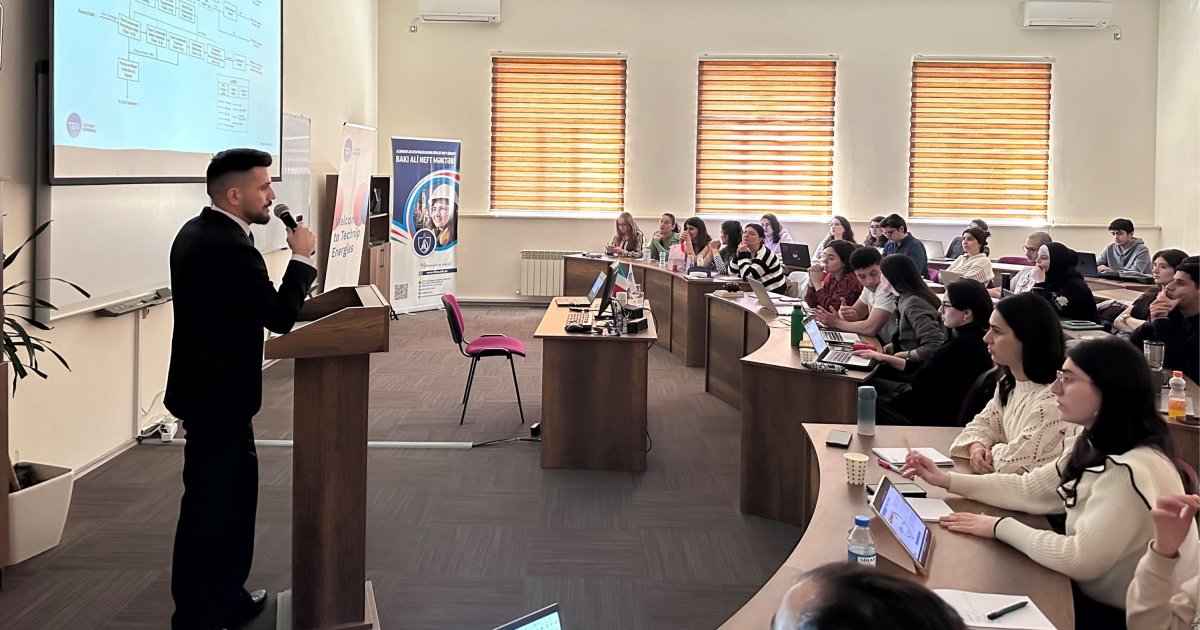
Since 2019, Technip Energies has run a structured technology-transfer program with three Baku universities, training roughly 50-60 final-year engineering students a year - about 250 in total - through six technical modules, internships and, since 2024, direct job offers.
Technip Energies, a French-headquartered engineering and technology group with a major office in Baku, identified a need to build a local pipeline of oil-and-gas and energy-transition engineers in Azerbaijan.
Objectives
To prepare final-year (and, since 2024, master's) engineering students from Baku's leading universities for careers in the energy sector, and to create a structured route from academic training into company internships and jobs.
Activities
Since 2019, each year roughly 50 to 60 students are selected from Baku Higher Oil School (BHOS), the Azerbaijan State Oil and Industry University (ASOIU) and, from 2023, the French-Azerbaijani University (UFAZ). Over about seven weeks they complete six technical modules on sustainable fuels, gas and low-carbon energy, offshore/onshore processes and digital transformation, taught by Technip Energies specialists based in France, Italy and the Netherlands, followed by a final business-case evaluation. The 2023 cohort was organised jointly with the Heydar Aliyev Foundation. Since 2024, top performers receive direct job offers followed by three months of international training, rather than only an internship route.
Results
By its fifth anniversary in 2025, the program had trained an estimated 250 students since 2019. In the 2023 cohort, 37 students completed the program (14 of them from UFAZ), with top performers advancing to interviews for internships at Technip Energies sites across Europe.
Conclusions
Output measures - cohorts trained, universities involved, internships and job offers - are well documented by the company and partner universities, but there is no independent, third-party evaluation of longer-term retention or career outcomes for participants.
Implementation
Indicative cost
Medium (€50k–€500k)
Time to results
Medium (1–3 years)
Staffing & skills
Technip Energies specialists based in France, Italy and the Netherlands teach the six technical modules, Three partner universities (BHOS, ASOIU, UFAZ) select and enrol final-year students, The Heydar Aliyev Foundation co-organised the 2023 cohort
Conditions for success
Structured, multi-year corporate-university partnership with a defined curriculum and final business-case evaluation
Clear progression pathway from coursework to internship interviews to (since 2024) direct job offers
Gradual expansion of partner universities and eligible student levels (bachelor's, then master's)
Where it fits
Governance type
corporate-academic partnership
Scale
national (3 Baku universities)
Income level
upper-middle income (Azerbaijan)
Do you run this practice?
Claim it —
verified implementers get a public contact pathway and can propose corrections.
Data sources
Where this practice's information was retrieved from, and when.
Created in 2011 under Morocco's energy ministry, IRESEN funds market-oriented renewable-energy research through a 14-lab university network and the Green …