Diawling National Park — Engineered Reflooding of the Senegal River Delta Floodplain (Mauritania)
Mauritania
Created to compensate for the Diama and Manantali dams, Diawling National Park's engineered dikes and sluices reflood the Senegal River …
Equatorial Guinea · Luba · See the Equatorial Guinea profile
Top 99% 13/100 · Ask Evidence Copilot about this practice
Since 1998, Drexel University and Equatorial Guinea's national university have monitored primates and nesting leatherback turtles on Bioko Island. Satellite tracking (2023) and market surveys show hunting and road access are still outpacing conservation gains.
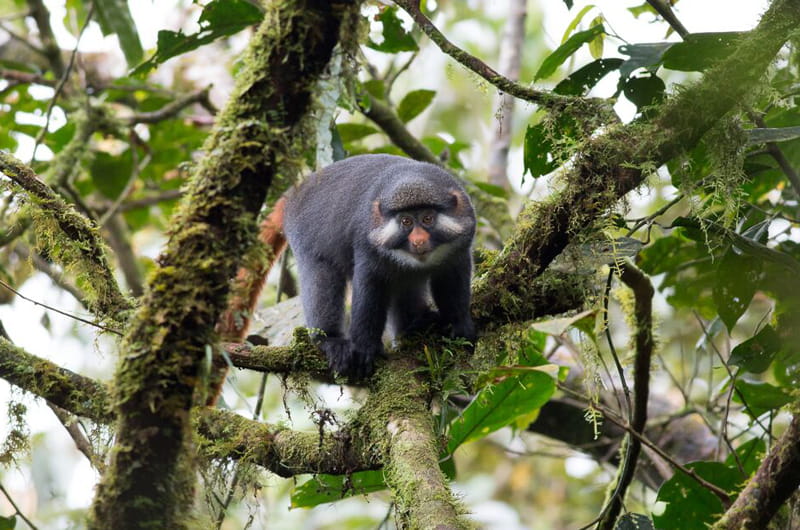
The Bioko Biodiversity Protection Program (BBPP) is a research and conservation partnership between Drexel University's Academy of Natural Sciences (Philadelphia) and the Universidad Nacional de Guinea Ecuatorial (Malabo), running since 1998. It focuses on Bioko Island's Gran Caldera de Luba and Southern Highlands Scientific Reserve, home to seven primate taxa — including the Critically Endangered Pennant's red colobus — and nesting beaches for four sea turtle species.
Long-running bushmeat market surveys tallied roughly 35,000 monkey carcasses sold in Malabo's markets between 1997 and 2010 (about seven per day). A road built through the reserve in 2015 increased hunters' access to previously remote areas. Satellite tracking of ten nesting leatherback turtles, published in PLOS ONE in 2023, found up to 444 individual females nest on Bioko annually, but recorded nesting numbers declining through 2008-2014; the existing marine reserve boundary (2km offshore, 120 km²) covers only about 9.8% of tracked turtles' time at sea, and researchers calculated a 15km boundary would be needed to cover roughly 55%.
A management plan for the reserve was finally ratified in 2021, and BBPP coordinates seven wildlife patrol teams alongside annual primate and turtle census expeditions. Independent peer-reviewed research (PLOS ONE 2023; Frontiers in Conservation Science 2022) documents that despite over two decades of monitoring and patrols, primate hunting intensity has continued to rise rather than fall as road access has expanded.
This practice is included as a cautionary case: sustained, scientifically rigorous monitoring has produced a strong evidence base, but has not yet translated into demonstrated population recovery.
Read the full analysis: https://drexel.edu/news/archive/2016/April/Bioko_Primate_Gun_Hunting
Implementation detail (cost, timeline, staffing, conditions for success) is not yet available for this practice.
Do you run this practice? Claim it — verified implementers get a public contact pathway and can propose corrections.
Where this practice's information was retrieved from, and when.
Mauritania
Created to compensate for the Diama and Manantali dams, Diawling National Park's engineered dikes and sluices reflood the Senegal River …
Guinea-Bissau
UNESCO named the 88-island Bijagos a Biosphere Reserve in 1996 and, in July 2025, a World Heritage Site. On the …
Peru
In April 2024 Peru granted its first Concession for Conservation over a lomas fog-oasis: 6,449 hectares in Ica region, protected …
Yemen
Since 1997, GEF-backed UNDP/UNOPS support has helped Yemen's Socotra Archipelago define 426 km2 of nature sanctuaries, national parks and resource-use …
Open full copilot Grounded in cited practices — always check the sources.