Cần Giờ Mangrove Biosphere Reserve — 47 Years Rebuilding a War-Defoliated Forest, Now Threatened by Development
Vietnam
Since 1978, Ho Chi Minh City has replanted roughly 20,000 ha of mangroves defoliated by US wartime herbicide spraying, earning …
Suriname · Weg naar Zee · See the Suriname profile
Evidence: Observational / pre–post Top 76% 33/100 · Ask Evidence Copilot about this practice
Permeable wooden dams and mangrove replanting at Weg naar Zee, Suriname, rebuilt about 1km of eroding coast, with mangroves re-establishing within nine months — though erosion and dike breaches persisted along the wider coast into 2024-2025.
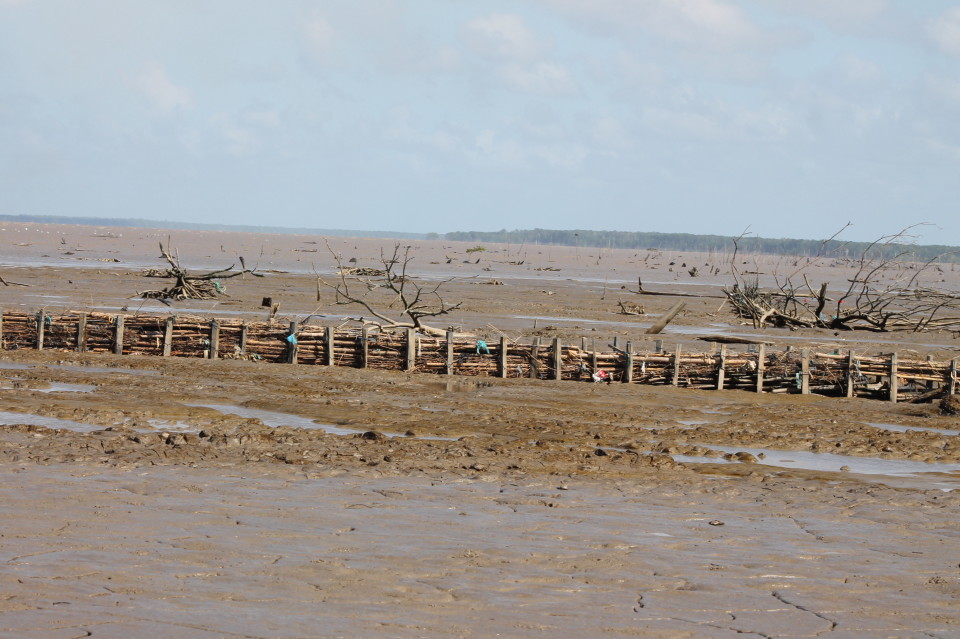
Suriname's low-lying, muddy coast near Paramaribo has historically eroded severely around Weg naar Zee, where mangrove forest had retreated and engineered sea defences were costly to maintain.
Between 2015 and 2016, Conservation International Suriname and Wetlands International, applying the 'Building with Nature' approach first piloted in Indonesia, constructed eight permeable dams of wooden poles and brushwood along roughly 1 km of coastline to slow currents and trap sediment.
Sediment accretion sufficient to support new mangrove seedling establishment was observed within about nine months of dam construction.
The intervention covered only a fraction of Suriname's ~10 km of critically eroding coastline; a 2024 assessment found erosion, sea-dike breaches and salinisation continuing along Weg naar Zee more broadly into 2024-2025, so the pilot's localised success has not been scaled to reverse coastline-wide erosion.
Philanthropic / foundation funding
Indicative funding routes for practices of this type — always check each programme's current calls and eligibility rules.
Do you run this practice? Claim it — verified implementers get a public contact pathway and can propose corrections.
Where this practice's information was retrieved from, and when.
Vietnam
Since 1978, Ho Chi Minh City has replanted roughly 20,000 ha of mangroves defoliated by US wartime herbicide spraying, earning …
Cameroon
Since 2022, Planète Urgence, Orange and Cameroonian communities have restored 100+ hectares of Wouri-estuary mangrove near Douala — including a …
Kiribati
Community volunteers under the World Bank/GEF-funded Kiribati Adaptation Program planted over 37,000 mangrove seedlings across six atolls; two Tarawa sites …
Jamaica
A World Bank/PROFOR study found Jamaica's mangroves prevent an estimated US$32.7m/year in flood damage; NEPA, UWI and partners have restored …
Open full copilot Grounded in cited practices — always check the sources.