Can't Wait to Learn — Closing the Numeracy Gender Gap for Refugee Children in Eastern Chad
Chad
A study across 20 schools in three refugee camps in Chad's Sila region found children using the tablet-based numeracy game …
Uganda · Isingiro · See the Uganda profile
An 18-month cluster-randomised trial across 30 primary schools and 1,507 children in Uganda's Isingiro District tested the adaptive tablet game Can't Wait to Learn against standard teaching — the first RCT to validate War Child's flagship digital-learning programme.
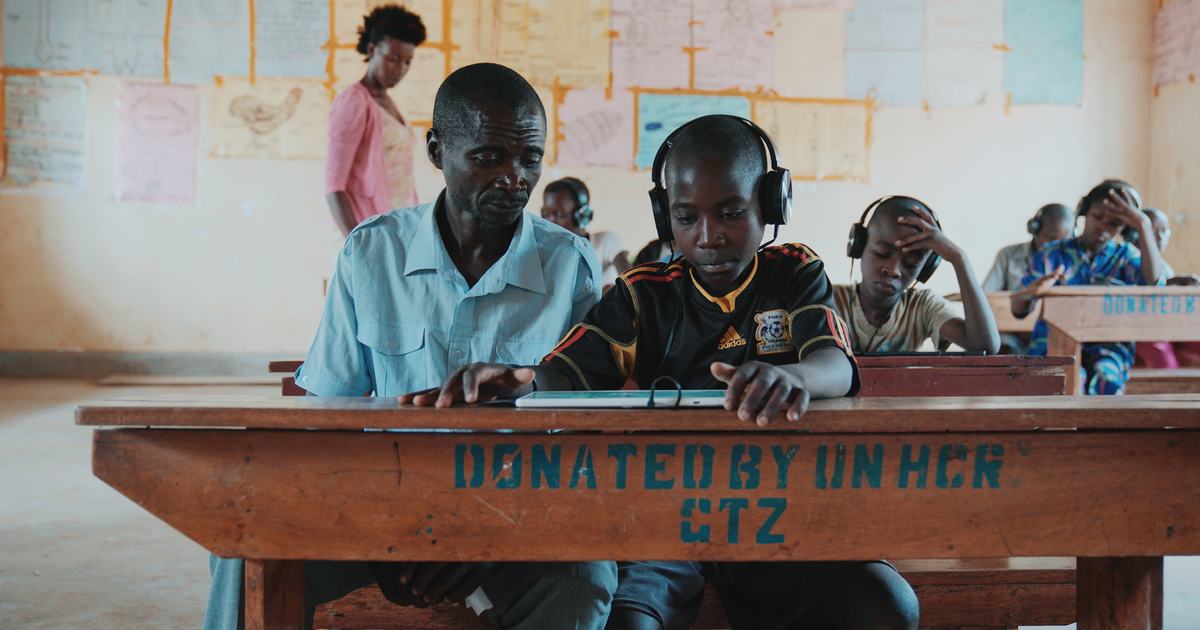
Can't Wait to Learn (CWTL) is War Child Holland's tablet-based adaptive learning game for children whose education has been disrupted. Uganda's Isingiro District, in the country's southwest near the Nakivale refugee settlement, hosted the programme's first cluster-randomised controlled trial (cRCT), funded by GPE KIX and run by War Child's research team together with Uganda's Ministry of Education and Sports.
Over 18 months, researchers followed 1,507 children across 30 primary schools. Schools were randomly assigned so that roughly half replaced part of their regular English and mathematics lessons with CWTL sessions — about 28% of weekly maths lessons and 25% of literacy lessons — while the other half continued standard instruction as the control arm.
War Child and GPE KIX describe the trial as evidence that CWTL 'not only performs better than standard education but also better than most EdTech programmes used in similar settings,' framing it as the milestone that turned CWTL into a fully evidence-based programme. A companion Value for Money analysis of the Uganda programme was published via GPE KIX in September 2024.
At the time of reporting, detailed statistical results (effect sizes, confidence intervals) had not yet appeared in a peer-reviewed journal — War Child stated these were forthcoming. This entry is therefore scored as a strong-design, pending-full-publication result rather than a fully documented RCT outcome, though the pre-registered cluster-randomised design is a methodological step up from most digital-learning evaluations in similar low-resource settings.
Where this practice's information was retrieved from, and when.
Chad
A study across 20 schools in three refugee camps in Chad's Sila region found children using the tablet-based numeracy game …
India
An adaptive learning system rigorously evaluated by MIT's J-PAL: students gained 2–2.5× the control group's progress in maths and language …
Uruguay
National adaptive mathematics platform (PAM) for all Uruguayan primary (grades 3-6) and lower secondary students since 2013. An independent CINVE …
Malawi
Malawi national programme deploying onecourse (onebillion) AI-adaptive tablets for Standards 1–4 literacy and numeracy across all 6,000 public primary schools …
Open full copilot Grounded in cited practices — always check the sources.