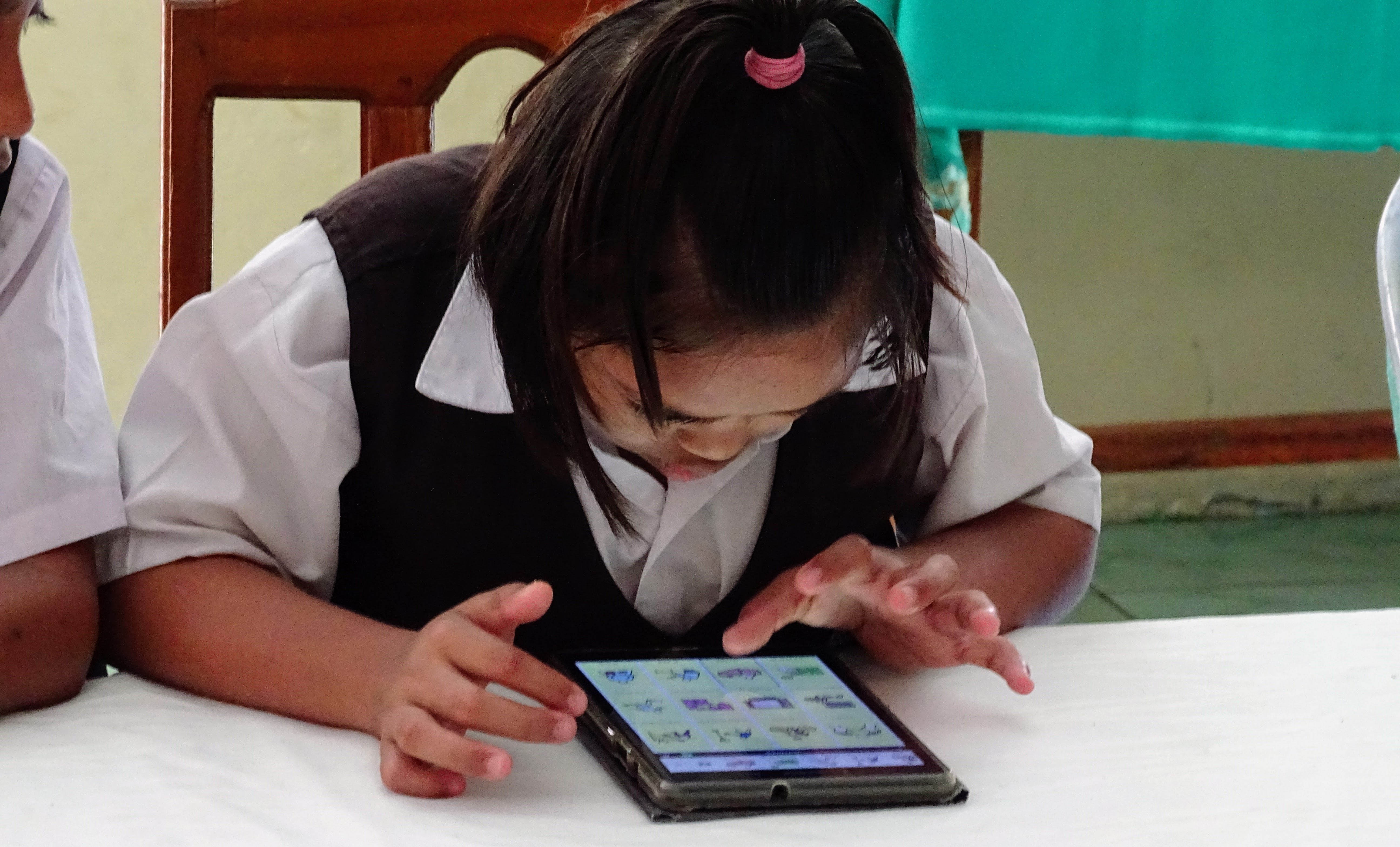
Four-month pilot of the free, open-source Cboard AAC app in three Timorese schools (Dili, Baucau), localised into Tetum and measured pre/post with the PIADS scale; early results were positive but small-scale.
Details
Promoter
Cboard (Assistive Communication LLC) with UNICEF Timor-Leste and Microsoft
Period
Sep–Dec 2023
Keywords
assistive technology, AAC, education, open source
Description
Cboard is a free, open-source augmentative and alternative communication (AAC) app with text-to-speech and symbol boards, started on GitHub in 2016 and backed by the UNICEF Innovation Fund (2017) and a Microsoft AI for Accessibility grant (2022). Between September and December 2023 Cboard, UNICEF Timor-Leste and Microsoft ran a four-month pilot in three schools: one in Dili and two in the municipality of Baucau. The app, an AAC guide and an activities manual were translated into Tetum with local translators, and PicSeePal donated 60 tablets to the Baucau schools that lacked devices and internet access. Impact was assessed with the Psychosocial Impact of Assistive Devices Scale (PIADS): forms were completed in September before use and again after 2–3 months, plus an in-person mid-pilot observation visit in October. Cboard's report describes a promising trend across all three PIADS domains, with parents and professionals reporting that children with communication needs integrated the app into daily life. Caveats: the public write-up gives no participant counts or scores, there is no control group, and the reporter is the app developer. An earlier UNICEF-supported pilot (from Nov 2019) with 125 children aged 3–12 and 70+ professionals in Croatia, Montenegro and Serbia found similar promising PIADS trends, with a learning curve for parents unfamiliar with technology.
Read the full analysis: https://www.cboard.io/en/blog/2024-01-20-timot-leste-report/
Implementation
Implementation detail (cost, timeline, staffing, conditions for success) is not yet available for this practice.
Do you run this practice?
Claim it —
verified implementers get a public contact pathway and can propose corrections.
Data sources
Where this practice's information was retrieved from, and when.
OLE Nepal deploys offline digital libraries (E-Pustakalaya) and interactive learning software (E-Paath) on local servers in remote Nepali schools without …