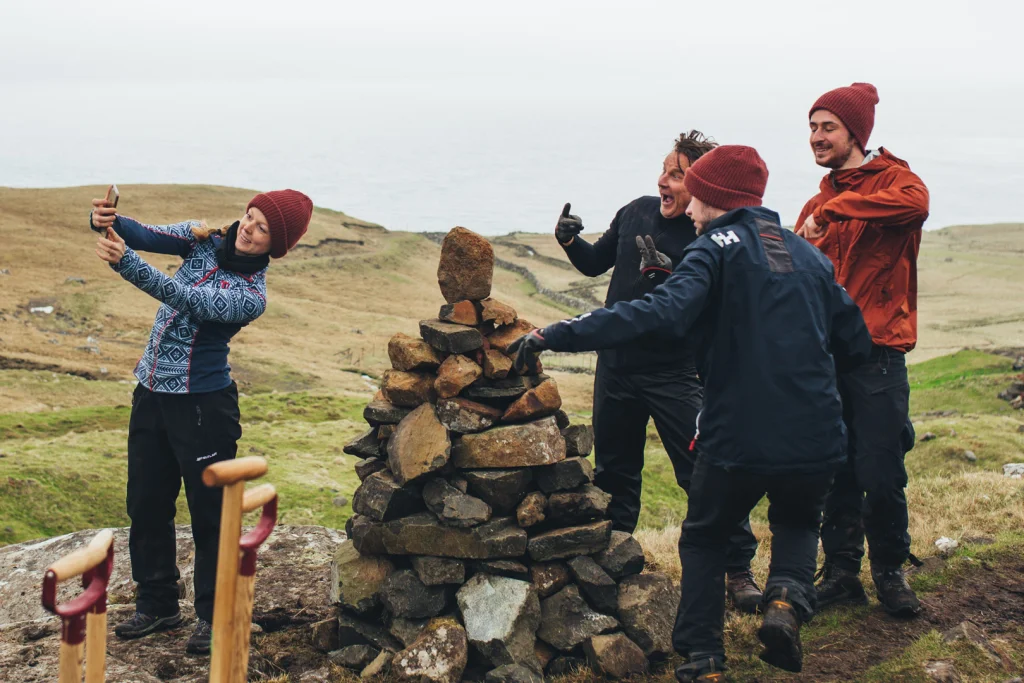
In February 2019 Visit Faroe Islands announced that the archipelago would be 'closed for maintenance': popular sites would shut to ordinary tourists for a weekend while selected volunteers repaired footpaths damaged by growing visitor numbers. The campaign drew over 3,500 applications in its first year and has run every year since, including 2020, when Faroese residents took part instead of foreign visitors.
According to Visit Faroe Islands' own figures, the programme has completed 72 projects on 46 sites across 12 islands. It has received 44,625 applications and involved 754 foreign and 279 Faroese volunteers from more than 54 countries. Each year 80–100 volunteers are selected, about 70% at random. Work includes building and draining trails with natural materials, placing trail-marker posts, repairing stone staircases and building platforms. At Fossá waterfall, for example, a trail and platform were built to stop trampling and erosion by keeping walkers on one route.
The scheme has been widely copied as a model of tourist-financed site stewardship, and the Nordic Labour Journal reports similar initiatives in Norway, New Zealand and Tasmania.
Caveats: it began as a marketing campaign, and Visit Faroe Islands says its evaluation is qualitative, based on post-event surveys and meetings. No trail-condition, vegetation-recovery or erosion measurements have been published, so environmental benefits remain plausible but unverified. Erosion-focused restoration such as the National Museum's separate Lendisbati project is outside this programme.
Read the full analysis: https://visitfaroeislands.com/en/closed/about5/facts-figures0
Where this practice's information was retrieved from, and when.