UNDP Green Aral Sea Initiative — Saxaul Afforestation on the Dried Seabed, Karakalpakstan
Uzbekistan
Since 2020, UNDP and Uzbekistan's forestry service have planted 823,000 saxaul trees over 658 hectares of the dried Aral Sea …
Iceland · Hella · See the Iceland profile
Evidence: Observational / pre–post Top 14% 60/100 · Ask Evidence Copilot about this practice
Since 2007, Iceland's Hekluskógar project has enlisted 210+ landowners to re-establish native birch woodland around the Hekla volcano, planting 2.3M+ seedlings by 2014 to curb the volcanic-ash erosion that has stripped half of Iceland's vegetation since settlement.
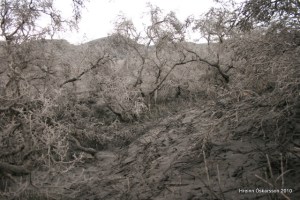
Iceland has lost an estimated half of its original vegetation cover — around 3 million hectares — to erosion since human settlement roughly 1,100 years ago, a process repeatedly worsened by ashfall from volcanoes such as Hekla, one of the country's most active.
Launched in 2007, the Hekluskógar project set out to re-establish native birch (Betula pubescens) and willow woodland across an approximately 90,000-hectare target area on Hekla's slopes, using a low-cost 'woodland island' strategy: small clusters of birch and willow are established with soil fertilisation and grass seeding on the most unstable ground, then left to spread naturally as seed sources recolonise the surrounding land.
By 2014, more than 2.3 million seedlings had been planted across 1,200+ hectares of small patches, with 210 landowners enrolled and all planting mapped into a GIS database, feeding ongoing ecological monitoring documented in the peer-reviewed study 'From Bare to Birch: Large-Scale Ecosystem Restoration in Iceland'. During the 2010 Eyjafjallajökull eruption, the young Hekluskógar woodland in the ash-fall zone reportedly 'survived and healed within a few weeks', an early indication that established woodland can buffer against tephra deposition better than bare, eroding ground.
The project remains a long-horizon effort: the 1,200+ hectares directly planted by 2014 represent a small fraction of the 90,000-hectare target, with most future gains expected to come gradually from natural woodland spread rather than further direct planting, progress that is difficult to independently verify without more recent monitoring data.
National / regional programmes
Indicative funding routes for practices of this type — always check each programme's current calls and eligibility rules.
Do you run this practice? Claim it — verified implementers get a public contact pathway and can propose corrections.
Where this practice's information was retrieved from, and when.
Uzbekistan
Since 2020, UNDP and Uzbekistan's forestry service have planted 823,000 saxaul trees over 658 hectares of the dried Aral Sea …
Indonesia
APRIL's Fire Free Village Programme pays Riau villages IDR 50–100 million for staying fire-free; a peer-reviewed 2019 study found programme …
Sierra Leone
In 2021 Freetown named Africa's first Chief Heat Officer, pairing the new office with solar-powered market shade canopies and a …
Fiji
In July 2026, Fiji and the FAO signed a $52.5M, seven-year Green Climate Fund project to restore over 80,000 ha …
Open full copilot Grounded in cited practices — always check the sources.