Gender Equality Action Plan 2022-2025 of CIHEAM
France
The Mediterranean Agronomic Institute of Montpellier (CIHEAM Montpellier) plays a pivotal role in promoting higher education, research, and development cooperation …
United Kingdom · Guildford · See the United Kingdom profile
Top 10% 96/100 · Ask Evidence Copilot about this practice
UK charity founded in 1992 that funds part-time, individually mentored fellowships for researchers (predominantly women) returning to STEM and, since 2020, all disciplines after a career break of two or more years.
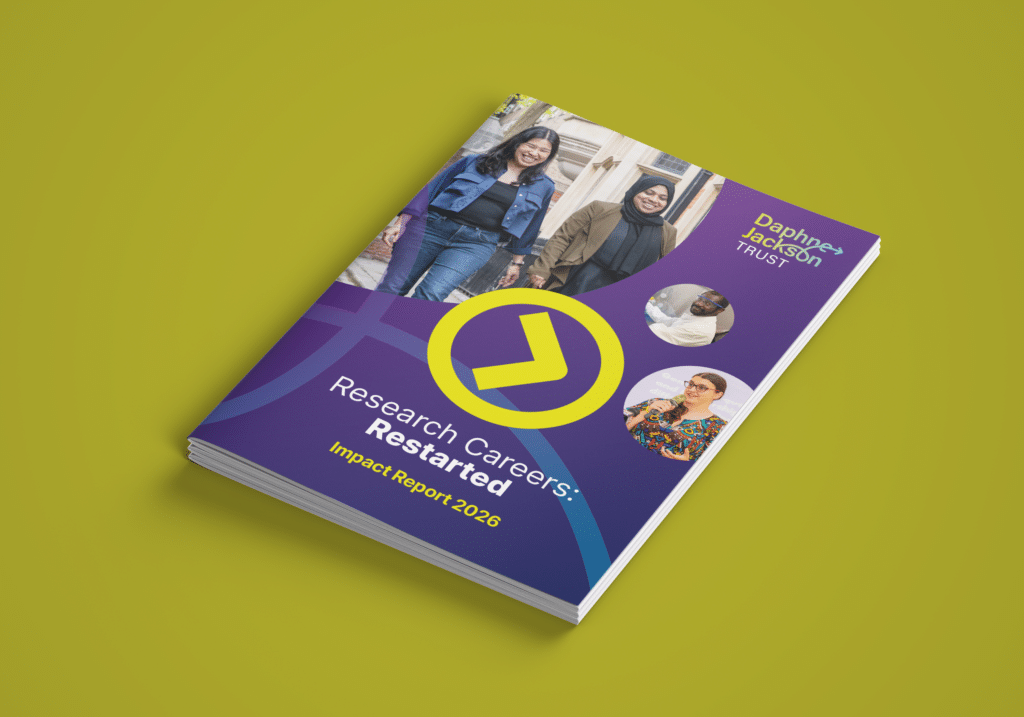
The Daphne Jackson Trust is a UK charity, founded in 1992 in memory of Daphne Jackson — the UK's first female professor of physics — to stop skilled researchers being permanently lost from the workforce after a career break of two or more years for caring, health or family reasons. The overwhelming majority of Fellows are women returning after maternity or caring leave.
Each Daphne Jackson Fellowship funds two years of part-time, supervised research at a host university or institution, combined with a retraining programme and individual mentoring, jointly funded by UK Research and Innovation (UKRI), learned societies, charities, industry and the host institution. Originally limited to science, engineering and technology, the scheme was widened in 2020 to all research disciplines and in 2021 added a Research Technical Professional Fellowship stream.
Since 1992 the Trust has supported over 500 Fellows. According to its own published impact data, more than 70% of former Fellows remain research-active five to ten years after their fellowship, around 60% continue at the same host institution, and alumni have gone on to secure more than £87 million in follow-on research funding — equivalent to roughly £3.50 raised for every £1 invested in a Fellowship — and produced over 2,200 peer-reviewed publications. The Trust estimates this has preserved over 2,400 cumulative years of research training and experience that would otherwise have been lost to the sector.
Caveats: the headline outcome figures (retention rate, funding leverage, publication counts) are drawn from the Trust's own alumni surveys and impact reporting rather than an independent randomised evaluation, and response/survivorship bias in alumni surveys cannot be ruled out. The scheme is also small relative to the scale of the 'leaky pipeline' problem it addresses (around 25 new Fellowships per year).
Read the full analysis: https://daphnejackson.org/fellows/impact-and-outcomes/
Implementation detail (cost, timeline, staffing, conditions for success) is not yet available for this practice.
Do you run this practice? Claim it — verified implementers get a public contact pathway and can propose corrections.
Where this practice's information was retrieved from, and when.
France
The Mediterranean Agronomic Institute of Montpellier (CIHEAM Montpellier) plays a pivotal role in promoting higher education, research, and development cooperation …
Vietnam
A randomised trial of 793 university men in Hanoi found GlobalConsent, a six-module web-based programme with a local drama series, …
Portugal
The GE-HEI project (Gender Equality in Higher Education Institutions) is a project funded by the Gender Conciliation and Equality Program …
Canada
Provincial laws publishing individual salaries above a threshold (from 1996) were followed by a 20–40% smaller gender pay gap among …
Open full copilot Grounded in cited practices — always check the sources.