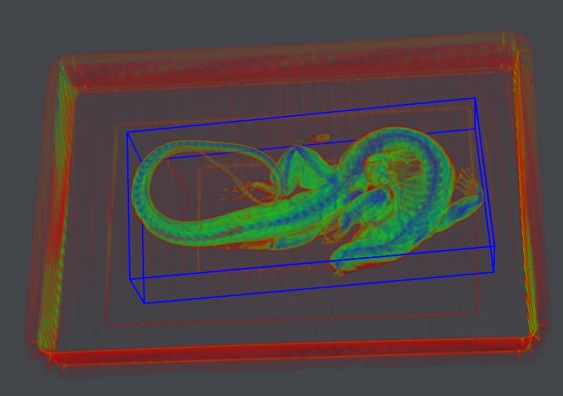
DCCEEW-backed researchers trialled a 3D X-ray CT scanner and machine-learning classifier on real seized mail at Sydney's international gateway; across 18 consignments (48 parcels, 116 reptiles and crustaceans) the best algorithm flagged concealed wildlife 56% of the time.
Field trial detection rate (real seized mail) (Jul 2023 - Jan 2024)
18 consignments (48 parcels)
Field trial consignments scanned (Jul 2023 - Jan 2024)
116 animals across 5 genera (87% reptiles)
Animals detected in field trial (Jul 2023 - Jan 2024)
200+ parcels (780 native animals)
Wildlife parcels intercepted (wider crackdown) (Jun 2023 - early 2025)
545 % increase
Rise in wildlife interceptions (Jun 2023 - early 2025)
8 years
Sentence given to wildlife trafficker (Feb 2026)
Details
Maturity
Pilot
Promoter
Department of Climate Change, Energy, the Environment and Water (DCCEEW) Wildlife Crime Special Investigators
Period
2022 lab validation; Jul 2023 – Jan 2024 field trial; published 2026
Keywords
wildlife conservation, customs & border security, law enforcement
Context
Researchers at Macquarie University and the Taronga Conservation Society, backed by Australia's DCCEEW and Department of Agriculture, Fisheries and Forestry, developed 3D X-ray CT scanning paired with machine-learning classifiers to detect wildlife concealed in international mail and luggage.
Objectives
The work aimed to give DCCEEW's Wildlife Crime Special Investigators a screening tool that could flag concealed live animals in mail parcels at Sydney's international gateway, building on a controlled 2022 validation study.
Activities
A first controlled validation, published in 2022, scanned 294 curated images across 13 species; DCCEEW investigators then trialled a Rapiscan RTT®110 scanner at the Sydney Gateway Facility between July 2023 and January 2024, scanning parcels that Australian Border Force staff had already flagged as suspicious, with no negative controls.
Results
The 2022 lab validation reached an 82% detection rate with a 1.6% false-alarm rate; in the real-world field trial across 18 seized consignments (48 parcels, 116 animals across five genera, 87% reptiles), the best-performing algorithm correctly flagged concealed wildlife in 56% of scans — a sharp drop from the lab figure. The wider DCCEEW crackdown intercepted more than 200 parcels containing 780 native animals between June 2023 and early 2025, a 545% rise in interceptions, and in February 2026 a linked investigation led to an 8-year sentence for a wildlife trafficker, the longest ever given to an Australian wildlife smuggler.
Conclusions
Researchers recommend a cloud-based mobile app to speed field use and formal investigator training on the companion pXRF provenance device, whose scan numbers were limited by staff availability, and note the approach depends on 3D CT scanners that are "not available everywhere."
Implementation
Indicative cost
Medium (€50k–€500k)
Time to results
Medium (1–3 years)
Staffing & skills
DCCEEW Wildlife Crime Special Investigators operated the scanner during the field trial, Researchers recommend formal training for investigators on the companion pXRF provenance device
Conditions for success
Access to a 3D X-ray CT scanner (Rapiscan RTT®110), which researchers note is 'not available everywhere'
Prior flagging of suspicious parcels by Australian Border Force staff to narrow the scanning workload
Sufficient trained-staff availability, which the study found limited pXRF scan numbers
Common failure modes
Real-world detection accuracy (56%) fell sharply from the curated lab validation (82%)
The field trial had no negative controls, since only already-flagged parcels were scanned
The approach has not yet been documented as replicated at another port or country
Where it fits
Governance type
national government agency (DCCEEW) with university/NGO research partners
Scale
single facility pilot (Sydney Gateway Facility)
Income level
high-income
Commonly funded by
National / regional programmesPhilanthropic / foundation funding
Indicative funding routes for practices of this type — always check each programme's current calls and eligibility rules.
Do you run this practice?
Claim it —
verified implementers get a public contact pathway and can propose corrections.
Data sources
Where this practice's information was retrieved from, and when.
AUSTRAC's Fintel Alliance embeds AI and machine-learning analytics shared with Australia's four largest banks. Alliance-coded suspicious-matter reports rose from 8,433 …