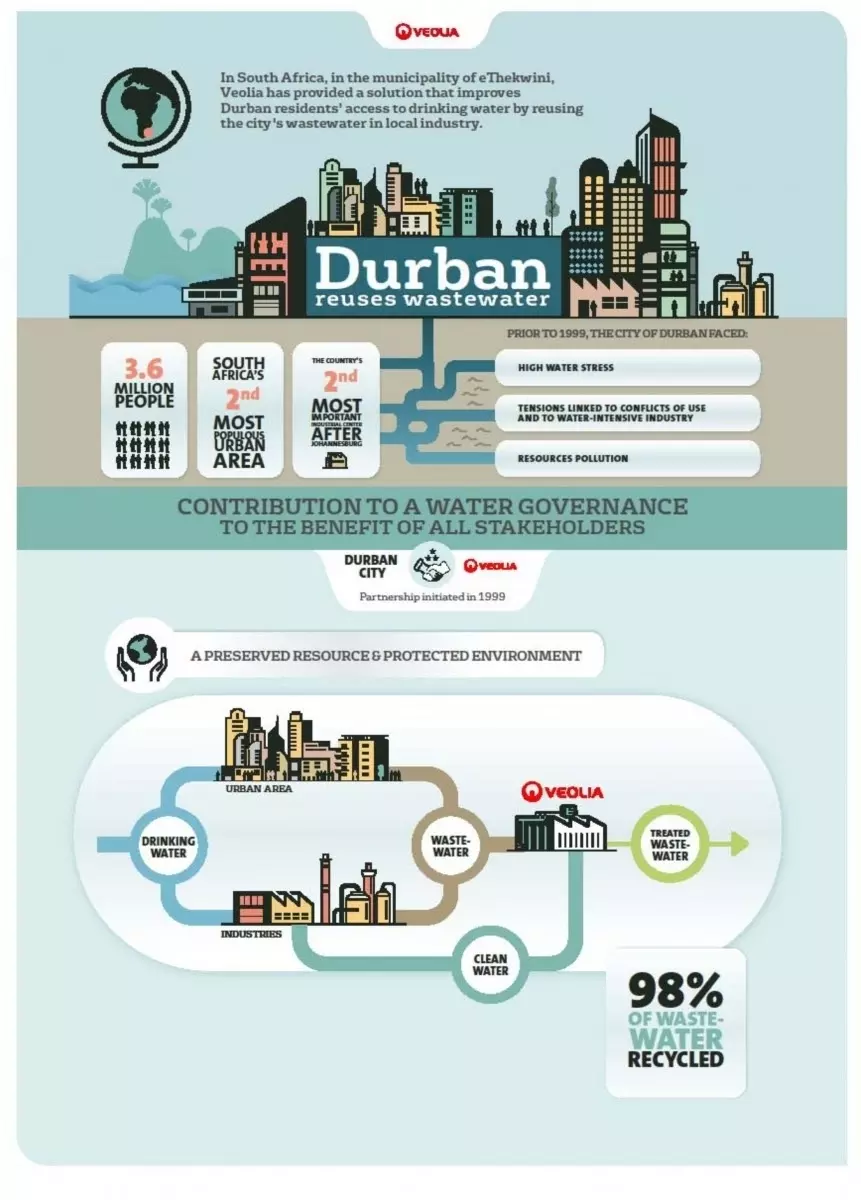
Since 2001, a private consortium (majority Veolia/Vivendi) has run a 47.5 ML/day plant reclaiming Durban's wastewater to near-potable industrial standard under a 20-year BOOT concession, supplying the Mondi paper mill and SAPREF refinery without municipal capital outlay.
eThekwini Municipality sought to avoid capital outlay for large-scale wastewater reclamation while freeing up potable water supply for other users in Durban, South Africa.
Activities
Durban Water Recycling was awarded via a 1999 tender as a 20-year Build-Own-Operate-Transfer concession; construction began in 2000 and the plant was commissioned in May 2001, producing tertiary-treated, near-potable industrial water at 47.5 million litres/day, monitored against roughly 22 quality parameters. DWR (Pty) Ltd, majority-owned by Vivendi Water (now Veolia) with partners Zetachem, Khulani Holdings, Umgeni Water and Marubeni Europe, financed, built, owns and operates the plant.
Results
The two main industrial customers, the Mondi paper mill and the SAPREF oil refinery, had combined offtake of approximately 37,500 m³/day per a 2004 trade-press report. Total capital cost was reported at around R74 million (~US$5M at the time), financed by the Development Bank of Southern Africa, Rand Merchant Bank, a French government protocol loan and DWR's shareholders.
Conclusions
The frequently repeated claim that DWR cuts Durban's potable demand by about 7% could not be traced to a primary source with a clear publication date, and detailed customer-volume figures mostly date to 2004 with no more recent independent figures found; a 2020 EU Chamber of Commerce South Africa report notes the model has not been widely replicated elsewhere in the country, citing insufficient government buy-in and regulatory obstacles.
Implementation
Indicative cost
Medium (€50k–€500k)
Time to results
Long (> 3 years)
Staffing & skills
Durban Water Recycling (Pty) Ltd operations team (Veolia/Vivendi Water majority owner), eThekwini Municipality oversight
Conditions for success
Build-Own-Operate-Transfer structure let the private consortium finance and operate the plant without municipal capital outlay, funded through industrial tariffs
Model has not been widely replicated elsewhere in South Africa, per a 2020 EU Chamber of Commerce report citing insufficient government buy-in, outdated municipal wastewater technology and regulatory obstacles
Commonly funded by
Own resources / municipal budget
Indicative funding routes for practices of this type — always check each programme's current calls and eligibility rules.
Replication kit
Reusable artefacts from this practice — as published by their sources.
United Utilities' £22.2M Sustainable Catchment Management Programme (2005-2015) paid tenant farmers across 57,000 hectares of Peak District and Forest of …