Shack Dwellers Federation of Namibia — Community-Led Savings and In-Situ Upgrading
Namibia
Since the early 1990s, Namibia's shack-dweller savings groups have secured land tenure for 3,200 households and self-built 1,350 homes at …
Egypt · Cairo · See the Egypt profile · See the Cairo profile
Evidence: Descriptive / self-reported Top 93% 43/100 · Ask Evidence Copilot about this practice
Established by decree in 2008, Egypt's ISDF graded unsafe informal areas by risk and by 2018 reported addressing 112 areas housing about 4 million Cairo residents, but independent research documents forced relocations and banned local commerce.
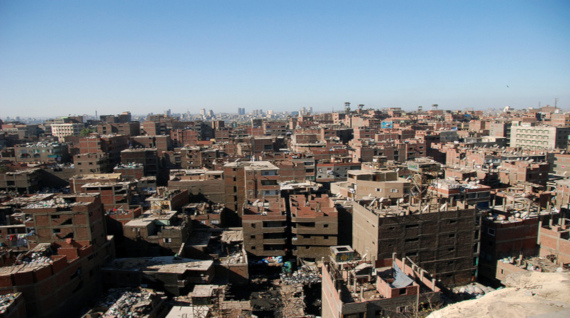
Egypt created the Informal Settlements Development Fund (ISDF, now folded into the Urban Development Fund) by presidential decree in late 2008, giving the national government a single body to identify and classify 'unsafe' informal housing across the country using a four-grade risk system: Grade One (life-threatening environmental/geological hazards), Grade Two (unsuitable building or site conditions), Grade Three (industrial pollution or missing basic services) and Grade Four (insecure land tenure).
The fund's objective was to triage and address unsafe informal housing nationally, prioritising the most life-threatening Grade One areas for clearance.
By 2013, ISDF had identified 365 unsafe areas nationally, estimated to house about 1.1 million people; a 2018 report focused on Cairo alone found 112 unsafe areas housing close to 4 million residents. Families cleared from central Cairo areas such as the Maspero Triangle and Duweiqa were relocated to purpose-built complexes 18-45km from downtown, with commercial activity banned in the new housing units.
The government prioritised Grade One clearance and in 2020 declared Egypt free of Grade-One unsafe housing, with President el-Sisi having pledged in 2018 to eliminate slums nationally. Independent research found that nearly 80% of compensated Maspero Triangle families reinvested their payouts back into informal housing rather than the formal units offered, and researchers have documented cases where lower-risk families were relocated ahead of higher-risk ones.
ISDF/UDF is genuinely one of the largest state-led informal-settlement programmes in the world by area and population addressed, and its four-grade risk classification is a distinctive policy tool. But it is a top-down, centrally administered model with limited resident participation in relocation decisions, and its self-reported 'unsafe housing eliminated' milestones should be read alongside independent academic findings of economic disruption and diminished livelihoods among relocated households — a cautionary counterpoint to community-co-produced upgrading models.
National / regional programmes
Indicative funding routes for practices of this type — always check each programme's current calls and eligibility rules.
Do you run this practice? Claim it — verified implementers get a public contact pathway and can propose corrections.
Where this practice's information was retrieved from, and when.
Namibia
Since the early 1990s, Namibia's shack-dweller savings groups have secured land tenure for 3,200 households and self-built 1,350 homes at …
South Africa
A 'second-generation' crime-prevention-through-design programme in Cape Town's Khayelitsha township pairs infrastructure upgrading with community safety work; a peer-reviewed 2020 study …
Pakistan
Since 1980, residents of Karachi's Orangi settlement have self-financed and self-built underground sewers guided by the Orangi Pilot Project, cutting …
Austria
Vienna houses roughly 44% of residents in subsidised housing, split between ~220,000 municipal flats and ~200,000 limited-profit dwellings; evidence is …
Open full copilot Grounded in cited practices — always check the sources.