Lusaka Sanitation Project — World Bank-Financed Sewer Upgrading for Zambia's Capital
Zambia
A $65M World Bank-financed programme rehabilitated and extended Lusaka's sewer network, connecting 345,000+ residents to sanitation services -- beating its …
Pakistan · Karachi · See the Pakistan profile · See the Karachi profile
Evidence: Observational / pre–post Top 9% 86/100 · Ask Evidence Copilot about this practice
Since 1980, residents of Karachi's Orangi settlement have self-financed and self-built underground sewers guided by the Orangi Pilot Project, cutting sanitation costs to roughly a fifth of municipal rates and reaching over a million people across 160+ lanes.
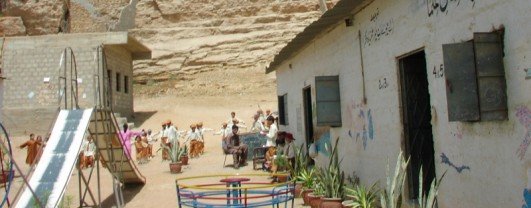
Orangi, a self-built squatter settlement on Karachi's north-western edge, housed roughly a million residents by the 1980s with no sewerage: households relied on bucket latrines and soak pits, and raw sewage ran in open lane drains, driving high rates of water-borne disease.
Extend affordable, dignified sanitation to Orangi residents by removing contractor profit from lane sewer construction and having residents finance and build their own connections, with government limited to funding the shared trunk infrastructure.
Social scientist Dr Akhtar Hameed Khan founded OPP-RTI in 1980 around a "component-sharing" model: residents of each lane organise, contribute labour and pay for their own underground sewer connecting to a shared collector, while OPP-RTI provides technical design, surveying and simple tools free of charge, leaving the trunk ("external") infrastructure for government agencies to connect.
Residents in Orangi built more than 99,000 low-cost household latrines and over 1.6 million feet of underground sewer lines, extending safe sanitation to more than one million people at roughly one-fifth of the cost the Karachi Municipal Corporation would have charged for equivalent contractor-built infrastructure. The lane-based model has been applied in 160+ Orangi lanes and extended to more than ten other Pakistani cities, with adaptations documented in Nepal, Central Asia and South Africa. The programme won the 1993 Aga Khan Award for Architecture and a World Habitat Award.
Independent reviews, including planner Arif Hasan's own assessment of the scale-up, note that replication elsewhere has been uneven — success depended heavily on strong local community organisers and a responsive local government willing to fund external trunk infrastructure, conditions not always present elsewhere; women's formal leadership within lane committees is also less documented than men's.
Own resources / municipal budget
Indicative funding routes for practices of this type — always check each programme's current calls and eligibility rules.
Do you run this practice? Claim it — verified implementers get a public contact pathway and can propose corrections.
Where this practice's information was retrieved from, and when.
Zambia
A $65M World Bank-financed programme rehabilitated and extended Lusaka's sewer network, connecting 345,000+ residents to sanitation services -- beating its …
Brazil
Rio de Janeiro's flagship in-situ favela-upgrading programme (1994–2008) delivered streets, drainage and services without removing residents; a peer-reviewed evaluation found …
Morocco
Morocco's national in-situ upgrading, rehousing and resettlement programme cut the share of urban households living in slums from 8.2% to …
Namibia
Since the early 1990s, Namibia's shack-dweller savings groups have secured land tenure for 3,200 households and self-built 1,350 homes at …
Open full copilot Grounded in cited practices — always check the sources.