KISIP — Kenya's Informal Settlements Improvement Project
Kenya
Kenya's national informal-settlements upgrading programme has prepared over 23,000 land titles and delivered roads, drainage, water and sewer connections that …
Namibia · Windhoek · See the Namibia profile · See the Windhoek profile
Evidence: Descriptive / self-reported Top 9% 86/100 · Ask Evidence Copilot about this practice
Since the early 1990s, Namibia's shack-dweller savings groups have secured land tenure for 3,200 households and self-built 1,350 homes at about a third of conventional cost. Namibia now targets nationwide informal-settlement upgrading by 2027, though land remains scarce.
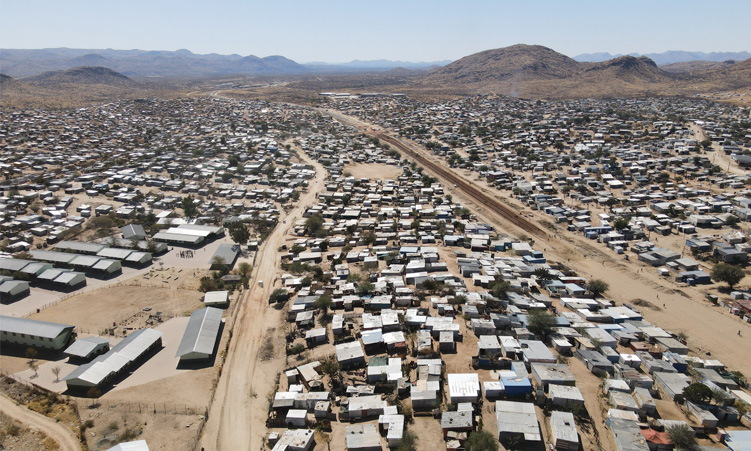
Since the early 1990s, the Shack Dwellers Federation of Namibia (SDFN) and its technical partner, the Namibia Housing Action Group (NHAG), have organised residents of informal settlements into daily community savings groups, run predominantly by women, that pool small contributions, negotiate directly with municipalities for serviced land, and jointly plan settlement layouts ('blockerf' plots) before building.
The model aims to secure land tenure and affordable, community-built housing for informal settlement residents by replacing individual, ad hoc negotiation and construction with collective savings, land negotiation and self-build financed through a member-managed loan fund.
Members can borrow from SDFN's Twahangana Fund, a community-managed revolving loan facility, to buy materials and build homes with their own labour. Savings groups also set aside support for elderly and terminally ill members. The federation has grown to around 23,000 members across roughly 700 savings groups nationwide.
To date, 3,200 households have secured land tenure through this process and 1,350 houses have been built, at roughly a third of the cost of contractor-built housing. Nationally, Namibia's 2023 census recorded 217,000 households (28.7% of the country's 756,339 households) living in informal settlements, against a national housing backlog of roughly 300,000 units.
In 2026, SDFN national facilitator Edith Mbanga urged the Namibian government to prioritise in-situ upgrading over relocation; the government has since set a 2027 target for informal-settlement upgrading, working with SDFN/NHAG and the post-2018 Community Land Information Programme. SDFN itself cautions that land scarcity is the binding constraint on scaling the model further.
Philanthropic / foundation funding National / regional programmes
Indicative funding routes for practices of this type — always check each programme's current calls and eligibility rules.
Do you run this practice? Claim it — verified implementers get a public contact pathway and can propose corrections.
Where this practice's information was retrieved from, and when.
Kenya
Kenya's national informal-settlements upgrading programme has prepared over 23,000 land titles and delivered roads, drainage, water and sewer connections that …
Indonesia
Starting in Jakarta in 1969, Indonesia's Kampung Improvement Programme threaded paved paths, drainage, water and sanitation into existing 'kampung' neighbourhoods …
Thailand
Thailand's Baan Mankong programme channelled government infrastructure subsidies and soft loans directly to community-run savings cooperatives, who then negotiated land …
Brazil
Rio de Janeiro's flagship in-situ favela-upgrading programme (1994–2008) delivered streets, drainage and services without removing residents; a peer-reviewed evaluation found …
Open full copilot Grounded in cited practices — always check the sources.