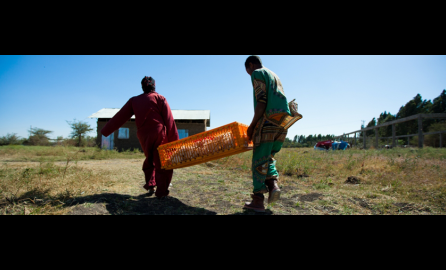
Ethiopia's government pays food-insecure rural households in cash or food for public-works labour on soil/water conservation and area-closure regeneration; Phase 5 alone treated 1.2M ha across 11,800 watersheds, though payment delays are a documented weakness.
1.2 million ha
Land treated with soil/water conservation works (Phase 5)
11800 watersheds
Watersheds treated (Phase 5)
~2,600
Community infrastructure assets completed or rehabilitated (Phase 5)
61.58 million EUR
EU financing for PSNP Phase 4
23 million+
People reached cumulatively with shock-responsive support
1.45 million households
Households that gained bank accounts through the programme
~1 million people
Labour-constrained people receiving unconditional transfers (12 months/year)
Details
Maturity
Established
Promoter
Government of Ethiopia — Ministry of Agriculture, Food Security Coordination Directorate
Period
2005-present (Phase 6 approved 2026)
Keywords
public-works PES, watershed rehabilitation, soil and water conservation, cash/food-for-work, rangeland restoration
Context
Since 2005, the Government of Ethiopia's Productive Safety Net Programme (PSNP), coordinated by the Ministry of Agriculture's Food Security Coordination Directorate with pooled financing from the World Bank (IDA), USAID, the UK's FCDO, the EU, Irish Aid, Sida and Canada, has combined social protection with environmental public works.
Objectives
Provide cash or food payments to food-insecure rural households for around six months of public-works labour a year building soil and water conservation structures, terracing and small-scale irrigation, and enclosing degraded hillsides as 'area closures' to let rangeland and forest regenerate naturally; around one million labour-constrained people also receive unconditional transfers for 12 months a year.
Activities
Under the most recently completed phase (PSNP 5), communities treated 1.2 million hectares of land across 11,800 watersheds and completed or rehabilitated nearly 2,600 community infrastructure assets. EU project-tracking data records EUR 61.58 million in EU financing for PSNP's fourth phase alone, pooled alongside other donors.
Results
Cumulatively, PSNP has reached over 23 million people with shock-responsive support, and 1.45 million households gained bank accounts through the programme. Independent academic research published in Global Environmental Change found that public-works watershed treatments measurably increased tree and woody cover in treated micro-watersheds relative to untreated comparison areas. The World Bank announced approval of the programme's sixth phase in March 2026.
Conclusions
The ecological outputs are real and independently measured, but multiple independent evaluations (including by IDS and 3ie, and analysis in the World Bank Economic Review) document persistent operational weaknesses: payment delays are one of PSNP's most recurring failures ('a safety net delayed is a safety net denied'), and political-economy studies have found targeting errors and non-need-based exclusions in some areas.
Implementation
Indicative cost
Very high (> €5M)
Time to results
Long (> 3 years)
Staffing & skills
Ministry of Agriculture's Food Security Coordination Directorate (programme coordination), Pooled donor financing and technical support from the World Bank (IDA), USAID, UK FCDO, EU, Irish Aid, Sida and Canada
Conditions for success
Sustained multi-donor pooled financing over two decades
Combining social-protection payments with environmental public works so that ecological and livelihood goals reinforce each other
Area-closure approach allowing degraded rangeland/forest to regenerate naturally
Linking beneficiary households to bank accounts to support shock-responsive delivery
Common failure modes
Payment delays are one of PSNP's most recurring and persistent failures
Targeting errors and non-need-based exclusions documented in some areas by independent political-economy studies
Commonly funded by
National / regional programmes
Indicative funding routes for practices of this type — always check each programme's current calls and eligibility rules.
Do you run this practice?
Claim it —
verified implementers get a public contact pathway and can propose corrections.
Data sources
Where this practice's information was retrieved from, and when.
Turkey's forestry ministry, with World Bank/GEF financing, has supported watershed communities since 2004 with saplings, irrigation tech and solar heaters; …
Estonia's EAFRD-funded Rural Development Plan pays private landowners €60–134/ha for Natura 2000 management restrictions. By 2019: €4.3 M/year for 64,000 …