Lord Howe Island Rodent Eradication Project
Australia
An AUD 15.5m operation cleared ship rats and house mice from Lord Howe Island's 1,455 ha in 2019; official surveys …
Falkland Islands (Malvinas) · Stanley · See the Falkland Islands (Malvinas) profile
Evidence: Quasi-experimental Top 76% 33/100 · Ask Evidence Copilot about this practice
Since 2001, Falklands Conservation and partners have cleared invasive Norway rats from 65 islands (~6,500 ha) for under £250,000; a peer-reviewed study found bird species richness on cleared islands matches historically rat-free islands within 1–11 years.
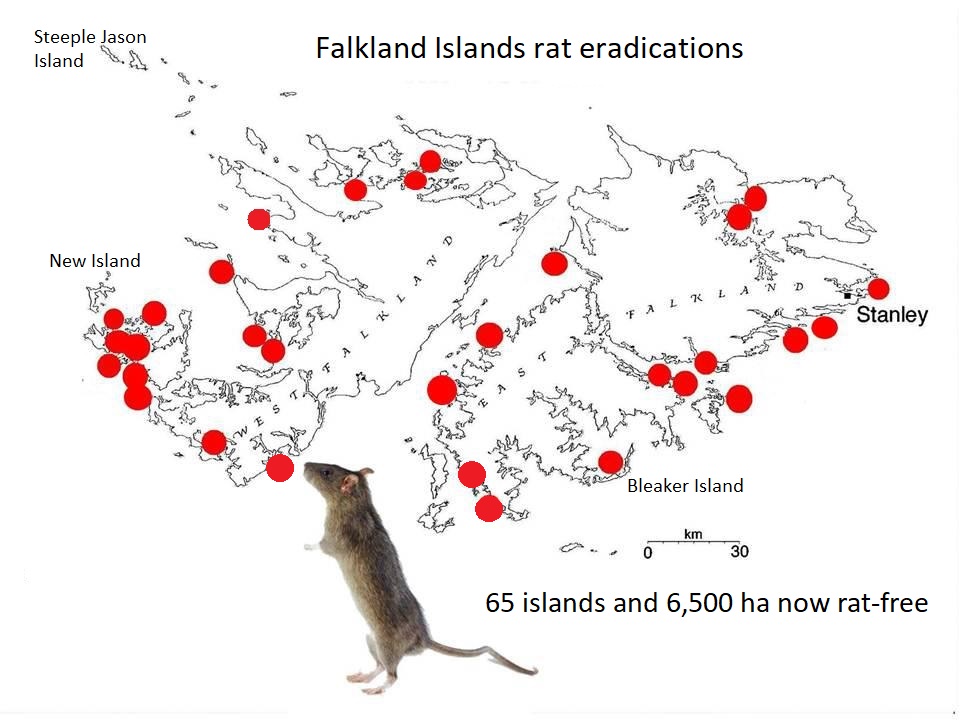
The Falkland Islands' offshore archipelago hosts globally important seabird and passerine populations, including the endemic Cobb's wren (Troglodytes cobbi), but introduced Norway rats (Rattus norvegicus) devastate ground-nesting birds on invaded islands.
From 2001, Falklands Conservation, the Wildlife Conservation Society (owner of Steeple Jason Island) and local landowners engaged New Zealand rodent-eradication specialist Derek Brown to run a rolling programme of island-by-island rat eradications using bait stations and trapping.
Between 2001 and 2019, the programme cleared Norway rats from 65 islands totalling roughly 6,500 hectares, ranging from under 1 hectare up to the 2,070-hectare Bleaker Island (cleared in 2019), for a cumulative cost of under £250,000, one of the most cost-efficient island-eradication records documented globally.
A peer-reviewed study (Tabak et al., Journal of Animal Ecology, 2015) surveyed 230 Falkland islands -- 85 still holding rats, 108 historically rat-free, and 37 post-eradication -- and found that passerine species richness on eradicated islands converged with that of historically rat-free islands within just 1-11 years, with strong recoveries of vulnerable species such as Cobb's wren and the blackish cinclodes.
26 additional islands that were cleared became re-invaded within five years, underscoring the need for sustained biosecurity monitoring, and two larger islands remain untreated because the terrain requires costlier helicopter-based operations.
Philanthropic / foundation funding
Indicative funding routes for practices of this type — always check each programme's current calls and eligibility rules.
Do you run this practice? Claim it — verified implementers get a public contact pathway and can propose corrections.
Where this practice's information was retrieved from, and when.
Australia
An AUD 15.5m operation cleared ship rats and house mice from Lord Howe Island's 1,455 ha in 2019; official surveys …
French Polynesia
In 2023, SOP Manu and BirdLife International used boat-launched drones to spread rodenticide across three seabird islets of Ua Pou, …
Seychelles
Since 1990, BirdLife International and Nature Seychelles eradicated rats and cats and moved the Seychelles magpie-robin to four more islands, …
United States of America
A 2011 aerial rat eradication on Palmyra Atoll (Island Conservation/TNC/USFWS) preceded a peer-reviewed study showing native tree seedlings rose from …
Open full copilot Grounded in cited practices — always check the sources.