Lord Howe Island Rodent Eradication Project
Australia
An AUD 15.5m operation cleared ship rats and house mice from Lord Howe Island's 1,455 ha in 2019; official surveys …
Seychelles · Victoria · See the Seychelles profile · See the Victoria profile
Evidence: Observational / pre–post Top 76% 33/100 · Ask Evidence Copilot about this practice
Since 1990, BirdLife International and Nature Seychelles eradicated rats and cats and moved the Seychelles magpie-robin to four more islands, growing the population from 16-23 birds on Frégate to 244-500 today, and downlisting it from Critically Endangered to Endangered.
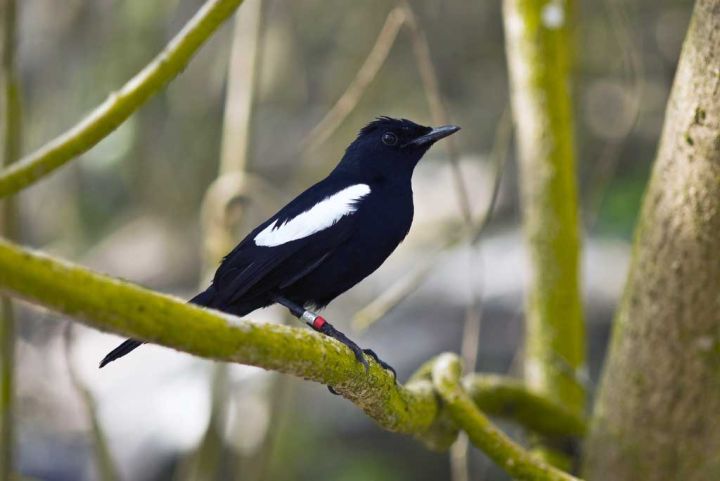
By the 1970s the Seychelles magpie-robin (Copsychus sechellarum) had collapsed to a single remnant population of as few as 16 to 23 birds, confined to Frégate Island, after introduced rats and feral cats had wiped it out everywhere else in the archipelago.
Recover the Seychelles magpie-robin from Critically Endangered status by eradicating invasive predators and translocating birds to additional predator-free, biosecure islands.
From 1990, BirdLife International began a translocation programme, later coordinated by Nature Seychelles through the Seychelles Magpie Robin Recovery Team (SMART). Each release required the target island to first be cleared of rats and cats and put under biosecurity. Birds were moved to Cousin Island (1994), Cousine Island (1995), Aride Island (2002) and Denis Island (2008). In parallel, the Island Conservation Society ran a separate 2005-2009 programme, funded by the French Global Environment Facility, that eradicated rats on North Island, Conception Island and the main islands of Cosmoledo Atoll.
Published census data put the population at 244-248 birds across five islands by 2012 (Frégate 115, Cousin 38, Cousine 31, Aride 24, Denis 36-40); more recent Nature Seychelles reporting puts the total nearer 500. The species was downlisted by the IUCN from Critically Endangered to Endangered, one of only 32 bird species reclassified positively worldwide between 1988 and 2008.
A 2022 genomic study (Cavill et al., Ibis) found extremely low genetic diversity across all five island populations, a legacy of the 1970s bottleneck that numeric recovery alone does not resolve — continued genetic and demographic monitoring is recommended.
Philanthropic / foundation funding
Indicative funding routes for practices of this type — always check each programme's current calls and eligibility rules.
Do you run this practice? Claim it — verified implementers get a public contact pathway and can propose corrections.
Where this practice's information was retrieved from, and when.
Australia
An AUD 15.5m operation cleared ship rats and house mice from Lord Howe Island's 1,455 ha in 2019; official surveys …
Saint Helena, Ascension and Tristan da Cunha
A three-phase cat eradication (2002–2006) let seabirds recolonize Ascension Island's mainland after roughly 180 years of absence: Ascension frigatebirds grew …
Japan
Japan's Ministry of the Environment declared the small Indian mongoose eradicated from Amami Oshima in 2024 after a 25-year, ¥3.57bn …
Bermuda
Bermuda government biologists have run continuous rat biosecurity and habitat restoration on the Bermuda petrel nesting islets since 1960, growing …
Open full copilot Grounded in cited practices — always check the sources.