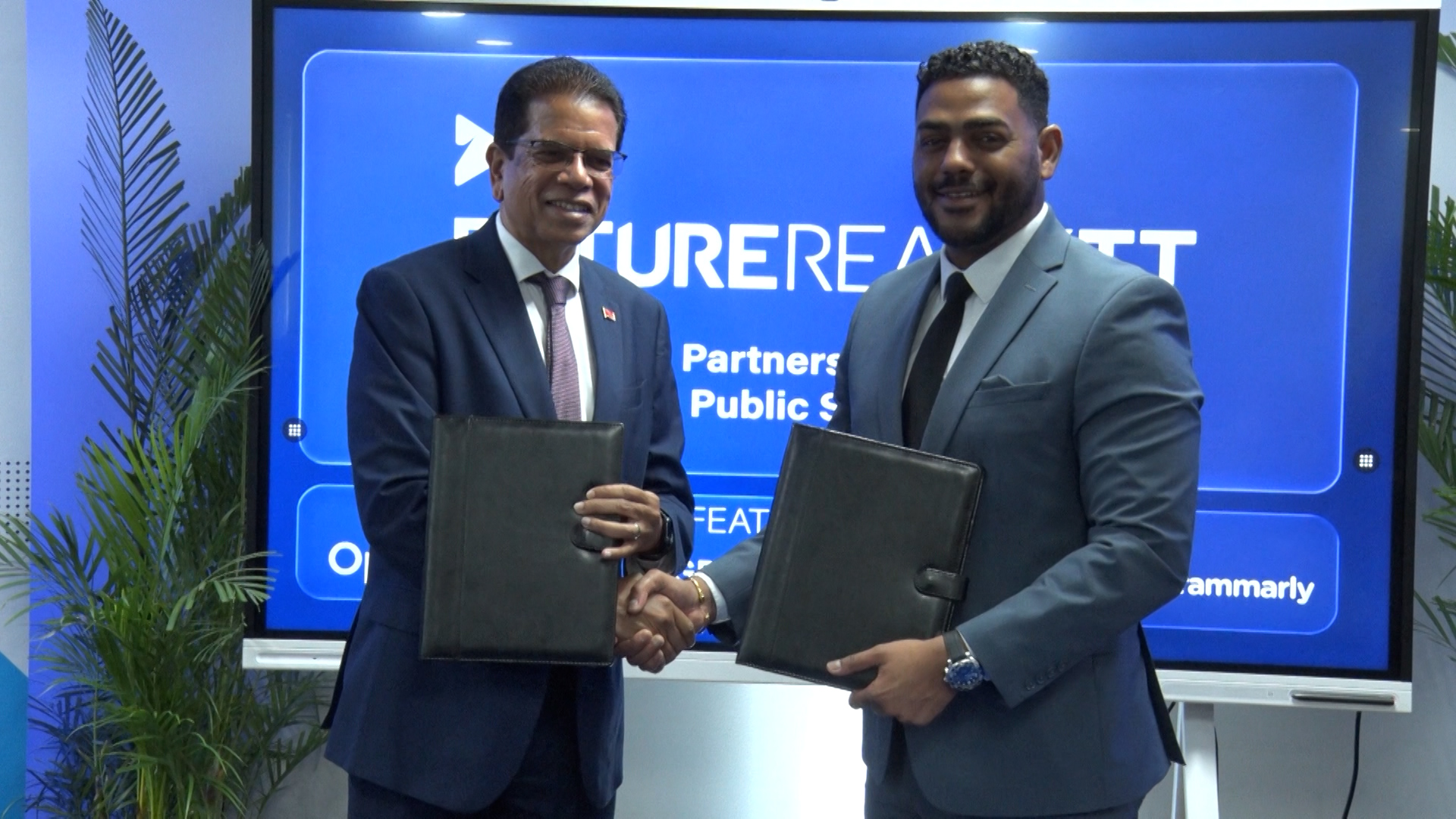
Trinidad and Tobago joined OpenAI's Education for Countries initiative (Jan 2026) and formalised 'Future Ready TT' (May 2026), rolling ChatGPT Edu and Grammarly into schools; a 550-licence public-sector pilot recorded 75% productivity gains, but no student data yet.
550
Public-sector pilot licences
75 %
Productivity increase among government pilot staff (self-reported, non-student)
Details
Maturity
Pilot
Promoter
Ministry of Public Administration and Artificial Intelligence / Ministry of Education, Trinidad and Tobago
Period
Jan 2026 (OpenAI partnership announced) – May 2026 (Future Ready TT formalised) – ongoing
Keywords
AI literacy, public sector AI, K-12 and tertiary education, government-OpenAI partnership
Context
The initiative began on 22 January 2026, when Minister Dominic Smith announced Trinidad and Tobago's selection for OpenAI's Education for Countries programme alongside Estonia, Greece, Jordan, Kazakhstan, Slovakia and the UAE. On 28 May 2026, Smith and Education Minister Dr Michael Dowlath signed the Future Ready TT partnership, rolling ChatGPT Edu and Grammarly into schools.
Results
The only quantified evidence is an internal 550-licence government pilot showing a 75% productivity increase among administrative staff; no student learning outcomes, teacher-training figures, or independent evaluations had been published as of mid-2026.
Conclusions
Government messaging emphasises critical AI evaluation and states technology should not replace people, but the programme's evidence base to date covers administrative staff productivity, not classroom or student impact.
Implementation
Indicative cost
Medium (€50k–€500k) — Enterprise licensing (ChatGPT Edu, Grammarly) intended for the public education system; only the 550-licence internal pilot's scope is quantified.
Time to results
Short (< 1 year) — Selected for OpenAI's Education for Countries programme 22 January 2026; Future Ready TT partnership formally signed 28 May 2026.
Staffing & skills
Ministry of Public Administration and Artificial Intelligence (Trinidad and Tobago), Ministry of Education (Trinidad and Tobago), OpenAI Education for Countries programme team, Grammarly (tool partner)
Conditions for success
Formal cross-ministry agreement (signed 28 May 2026) being carried through to actual classroom/school deployment
Publishing student-level learning outcome data, which does not yet exist
Structured teacher-training curriculum for the tools, which is not yet documented beyond a 2025 professional-development workshop
Common failure modes
Only quantified evidence to date (75% productivity increase) applies to administrative staff in a 550-licence internal government pilot, not to students or schools
No student learning outcomes, teacher-training figures, or independent evaluations published as of mid-2026
No structured teacher-training curriculum for the classroom tools documented
Where it fits
Governance type
national government partnership with OpenAI (Education for Countries initiative)
Scale
national rollout intent; internal pilot currently 550 licences
Income level
high-income
Commonly funded by
National / regional programmes
Indicative funding routes for practices of this type — always check each programme's current calls and eligibility rules.
Do you run this practice?
Claim it —
verified implementers get a public contact pathway and can propose corrections.
Data sources
Where this practice's information was retrieved from, and when.
A 5-week AI-literacy module for pre-service physics teachers across nine Kazakhstani universities, led by Zhetysu University, raised literacy scores far …