Aravalli Biodiversity Park — A Citizen-Led Rewilding of a Gurugram Stone-Mining Site Into India's First OECM
India
A 380–392-acre former stone-mining site in Gurugram, restored since 2010 by the city and the residents' group iamgurgaon. It has …
Portugal · Porto · See the Portugal profile · See the Porto profile
Top 35% 47/100 · Ask Evidence Copilot about this practice
A university-municipal network restoring native urban forest across Porto's 17-municipality metro area: 106,019 native trees on 174 ha by 2018, 16,776 volunteer participations, and published monitoring showing 80-92% four-year survival at some sites but 56% at another.
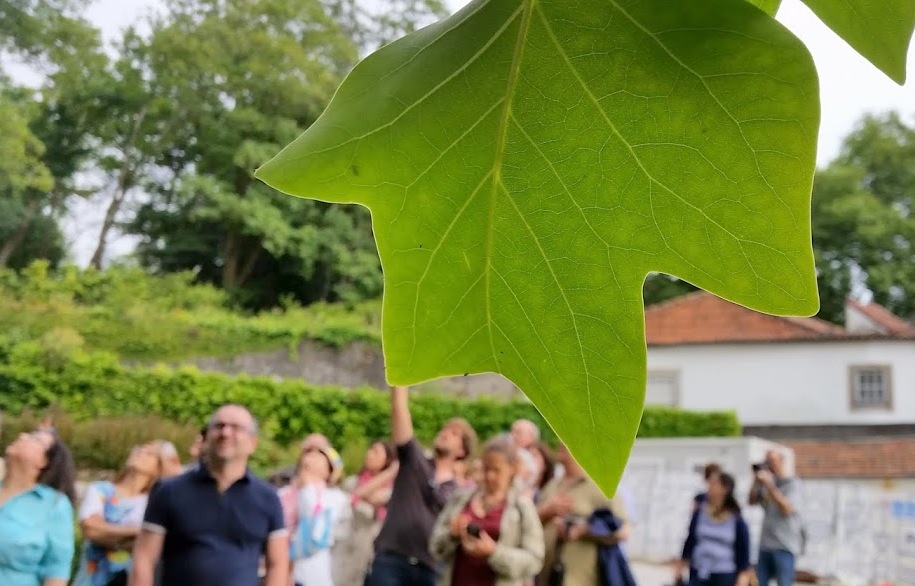
FUTURO was launched in 2010 as the first project of CRE.Porto, the UN University-recognised Regional Centre of Expertise on Education for Sustainable Development hosted by the Universidade Católica Portuguesa, together with the Área Metropolitana do Porto (AMP). It responded to a metropolitan landscape where more than 90% of forest land is intensive maritime-pine and eucalyptus plantation, invasive plants are spreading and wildfires are frequent. The goal was to plant 100,000 native trees (oaks, cork oaks, strawberry trees, holly and others) on about 100 hectares of degraded, burnt or abandoned public and private land.
Municipal forestry offices and landowner associations plan each site, the CRE.Porto team acts as a bridging organisation, and citizens join scheduled planting and maintenance days. Early progress was slower than planned: in February 2013 the project reported 19,060 plants with about 3,000 volunteers in 13 municipalities, and the original 2016 deadline slipped.
The project's eight-year report states that the 100,000th tree was planted in 2018, with 106,019 native trees on 174 hectares, 16,776 volunteer participations (54,340 volunteer hours), 627 volunteer activities, around 350 entities involved and about EUR 400,000 attracted. Annual monitoring campaigns measure planting survival: 80-92% after four years at several sites, but 56% at the Viveiros da Granja area. Carbon (about 9,877 t gross per year) and air-pollutant figures are modelled potentials for the trees at maturity, not measured stocks.
Lessons: a light coordinating body plus municipal forestry staff can mobilise a whole metro region at modest cost, and publishing survival rates rather than just planting counts is what makes the claim checkable. Biodiversity, soil and fire-risk benefits remain asserted rather than measured.
Read the full analysis: https://www.100milarvores.pt/
Implementation detail (cost, timeline, staffing, conditions for success) is not yet available for this practice.
Do you run this practice? Claim it — verified implementers get a public contact pathway and can propose corrections.
Where this practice's information was retrieved from, and when.
India
A 380–392-acre former stone-mining site in Gurugram, restored since 2010 by the city and the residents' group iamgurgaon. It has …
Japan
Some 100,000 donated trees of 365 species were hand-planted by ~110,000 volunteers on 70 ha of open land around 1920, …
Côte d'Ivoire
A ~3,400 ha rainforest park inside Abidjan. A GIZ/UFZ natural-capital study found wells on its edge supply 64% of the …
Portugal
Decreed in 1934 and planted from 1938 on soil exhausted by cereal farming, Monsanto is a ~1,000-ha urban forest (~10% …
Open full copilot Grounded in cited practices — always check the sources.