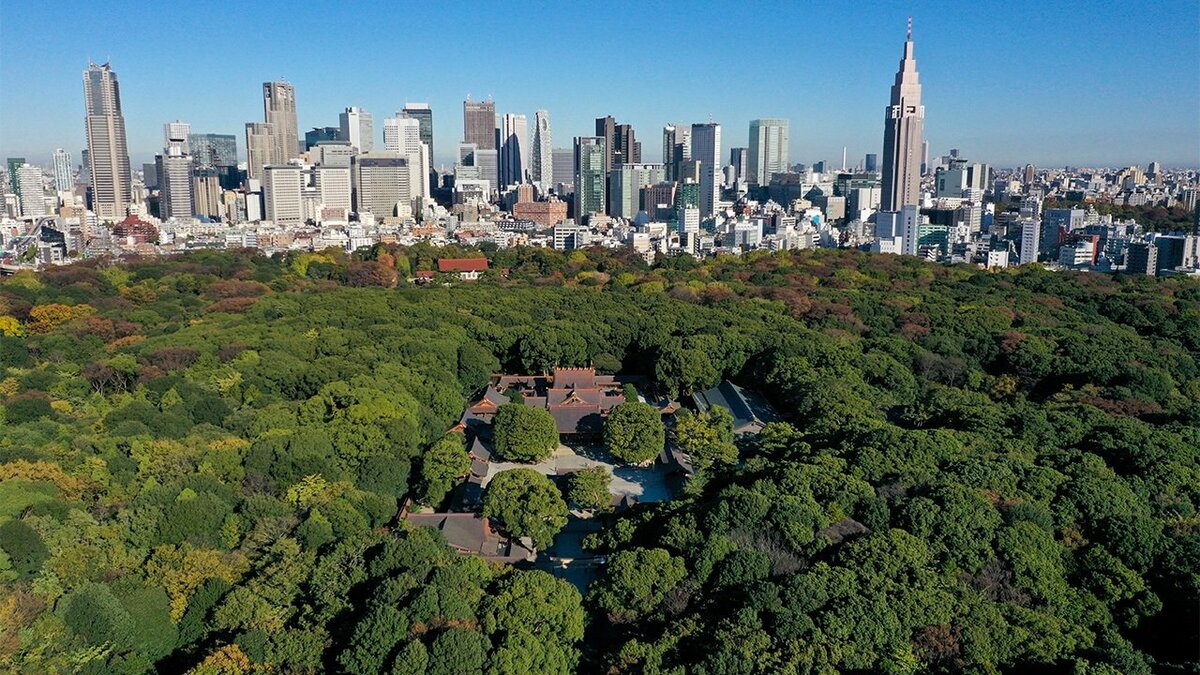
When Meiji Shrine was built in central Tokyo (Shibuya), only about 8 of the roughly 70 hectares of the inner precinct were wooded. Forestry scientists Honda Seiroku, Hongō Takanori and Uehara Keiji drew up a long-term plan in which the planting would pass through four 50-year stages, from a mix of pines and fast-growing conifers to a mature, self-regenerating forest dominated by evergreen broadleaves native to the region.
Trees were donated from across Japan and its then-territories: about 95,559 trees of 365 species from the public, around 122,000 in all by some counts. Roughly 110,000 young volunteers planted them and built the approach paths. The shrine was dedicated in November 1920.
The forest has been managed with minimal intervention. Fallen leaves and trees are left on the forest floor so nutrients cycle in place. A comprehensive survey led by Shinji Isoya, involving about 1,000 plant and wildlife specialists and published in 2013, built on a 1980 baseline. It recorded about 234 tree species, down from the 365 originally planted, which the shrine attributes to natural selection. It concluded the forest was ahead of schedule toward its planned mature stage.
Evidence is strongest for structural and biodiversity outcomes. Carbon storage, cooling and stormwater effects have not been quantified in the sources consulted, and the adjacent outer garden (Jingu Gaien) has since become contested over a redevelopment that involves tree felling.
Read the full analysis: https://www.nippon.com/en/japan-topics/g00866/
Where this practice's information was retrieved from, and when.