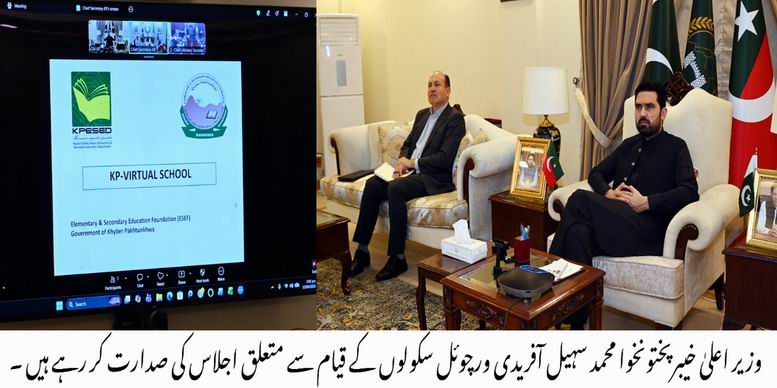
Khyber Pakhtunkhwa's Global Virtual School piloted an always-on AI teacher — answering questions in Urdu, English and Pashto — across 46 government schools in remote districts, with Rs. 153.8 million approved to expand to 175 schools.
46 schools
Government schools running GVS (pilot) (2026)
33 schools
Settled-district schools (2026)
13 schools
Merged (formerly tribal) district schools (2026)
153.80 million PKR
Approved total project cost
44.85 million PKR
Tele Education Centre budget
175 schools
Planned expansion, next phase
Details
Maturity
Pilot
Promoter
Elementary and Secondary Education Foundation (ESEF), Government of Khyber Pakhtunkhwa
Period
Pilot from early 2026; provincial expansion approved April 2026
The Government of Khyber Pakhtunkhwa's Elementary and Secondary Education Foundation (ESEF) launched the Global Virtual School (GVS), a public-sector online schooling system for students in remote and underserved areas of the province, covering grades 6-12 in English, Mathematics, Physics, Chemistry and Biology.
Objectives
Extend quality schooling, including an always-on AI teacher, to remote and merged (formerly tribal) districts historically underserved by the school system.
Activities
By the pilot phase, 46 government schools were running the online system - 33 in settled districts and 13 in merged districts - delivered through a central digital teaching studio with live interactive classes and a dedicated Tele Education Centre. The AI teacher explains lessons, answers questions and gives personalised support in Urdu, English and Pashto, alongside supplementary foreign-language content (Chinese, German, Korean, Japanese), virtual labs and progress tracking.
Results
Chief Minister Muhammad Sohail Afridi approved a total project cost of Rs. 153.80 million, including Rs. 44.85 million for the Tele Education Centre, and virtual-school students were formally accorded regular student status. The province approved expansion to 175 additional schools in the next phase, with an ambition to reach 500 schools.
Conclusions
As of the pilot, no independent evaluation of learning outcomes has been published, so the programme's impact on student achievement remains unverified even as its infrastructure and reach scale up.
Implementation
Indicative cost
High (€500k–€5M) — Rs. 153.80 million approved total project cost, including Rs. 44.85 million for the Tele Education Centre.
Time to results
Medium (1–3 years) — Piloted with 46 schools from early 2026; expansion to 175 schools approved April 2026, with an ambition to reach 500 schools.
Staffing & skills
Elementary and Secondary Education Foundation (ESEF), Government of Khyber Pakhtunkhwa, Central digital teaching studio staff, Dedicated Tele Education Centre team
Conditions for success
Central studio delivering live interactive classes to remote schools
Multilingual AI teacher (Urdu, English, Pashto) for local-language support
Formal regular student status granted to virtual-school students
A World Bank-designed randomized controlled trial gave about 800 Edo State, Nigeria senior-secondary students six weeks of after-school, teacher-guided ChatGPT …
Asker Municipality and the University of Oslo tested subject-adapted conversational AI chatbots in classrooms (~200 pupils, 2024; three lower-secondary schools, …