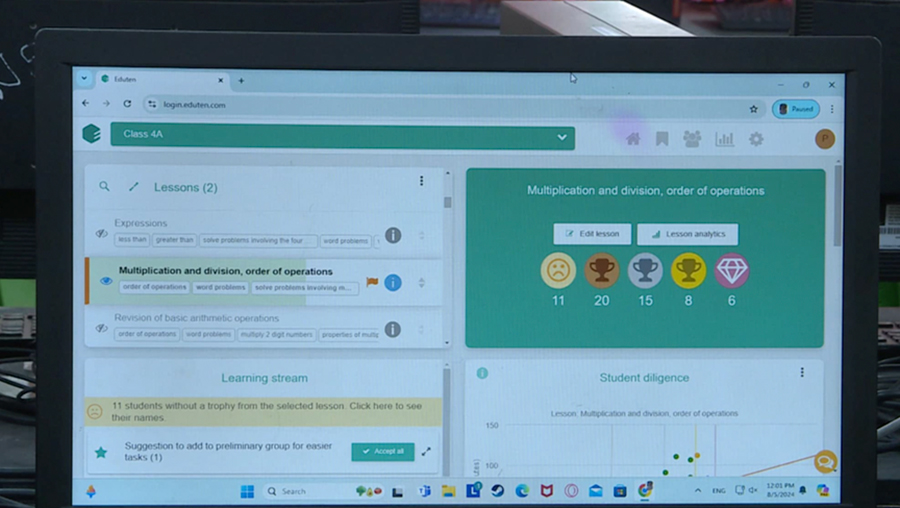
A UNICEF-backed pilot of Finland's AI-powered Eduten maths platform in 32 Bhutanese schools found Grade 5 pupils gained 11.2pp in numeracy and 4.6pp in arithmetic fluency over a control group; Bhutan funded a full Grade 4 rollout, expanding to Grade 5 (2025) and Grade 6 (2026).
11.2 pp
Numeracy gain over control group (10-week pilot)
4.6 pp
Arithmetic fluency gain over control group (10-week pilot)
952
Students in pilot
32
Schools in pilot
92%
Students who reported enjoying maths more
Nu 12 million
Year-one licensing commitment (year one of 3-year agreement)
Details
Maturity
Scaling
Promoter
Bhutan Ministry of Education and Skills Development (MoESD); UNICEF Bhutan; Eduten Oy (Finland)
Period
2024 pilot; national rollout 2024–2026
Keywords
K-12 education, mathematics, EdTech
Context
Eduten, a Finnish AI-powered adaptive mathematics platform used in over 70% of Finnish schools, was piloted with 952 Grade 5 students across 32 schools in Bhutan — six urban schools including Loselling Middle Secondary School and Etho Meto Primary in Thimphu, and 14 rural schools including sites in Pema Gatshel and Sarpang.
Objectives
UNICEF Bhutan's evaluation set out to test whether the AI-adaptive platform could improve numeracy and arithmetic fluency compared with a control group over a 10-week pilot period with one weekly lesson.
Activities
Pupils used the platform for one weekly lesson over 10 weeks, with UNICEF Bhutan comparing participating students against a control group. Following the pilot, Bhutan's Ministry of Education and Skills Development (MoESD) fully funded a nationwide rollout to all Grade 4 students under a three-year agreement, with phased expansion to Grade 5 in 2025 and Grade 6 in 2026, including monastic schools attended by young monks.
Results
Pupils using Eduten outperformed the control group by 11.2 percentage points in overall numeracy and 4.6 percentage points in arithmetic fluency. 92% of students reported enjoying maths more, and teachers reported reduced workload thanks to automated learning analytics, with one educator describing a 'vast difference in learning outcome' compared with traditional instruction.
Conclusions
The published control-group comparison does not disclose randomisation procedures or formal significance testing, so the results should be read as a promising quasi-experimental signal rather than a definitive causal effect. A parallel Eduten pilot is under way in neighbouring Laos as part of the same UNICEF-supported regional programme.
Implementation
Indicative cost
Medium (€50k–€500k)
Time to results
Long (> 3 years)
Staffing & skills
Classroom teachers delivering the weekly Eduten lesson, UNICEF Bhutan evaluation team, Eduten Oy (Finland) platform provider
Conditions for success
Ministry (MoESD) funding commitment under a three-year licensing agreement
Phased grade-by-grade rollout (Grade 4 then 5 then 6) rather than a one-shot national launch
Deliberate inclusion of rural and monastic schools alongside urban schools
Common failure modes
Published control-group comparison does not disclose randomisation or significance testing
Continued national scale-up depends on sustained government licensing funding
Commonly funded by
National / regional programmesPhilanthropic / foundation funding
Indicative funding routes for practices of this type — always check each programme's current calls and eligibility rules.
Do you run this practice?
Claim it —
verified implementers get a public contact pathway and can propose corrections.
Data sources
Where this practice's information was retrieved from, and when.
Parallel Eduten AI-adaptive maths pilot under way across 5 provinces, 12 districts and 35 primary schools in Laos, as part of the same UNICEF-supported regional programme as the Bhutan rollout.
American Samoa's Department of Education rolled out Alef Education's AI-adaptive math platform to all 10,000 public-school students, starting with high …
A Lithuanian philanthropic foundation supplied AI-powered adaptive maths platforms to regional schools outside Vilnius, reaching over 13,000 students and training …
MBRGI's Digital School launched a three-year AI-personalised learning rollout across six African countries including Mauritania, pairing 100 digital learning spaces …