NIHSA Annual Flood Outlook — Nigeria's AI-Assisted Flood Risk Forecasting Across 250+ Monitoring Stations
Nigeria
Nigeria's Hydrological Services Agency says it deployed deep-learning models trained on 200+ years of flood data for its 2026 Annual …
Bangladesh · Dhaka · See the Bangladesh profile
Since 2020, Google Research's machine-learning flood model — which forecasts river levels even in ungauged basins — has combined with Bangladesh Water Development Board data to push flood alerts; by 2021 it reached 1.5 million users with a lead time of three hours to three days.
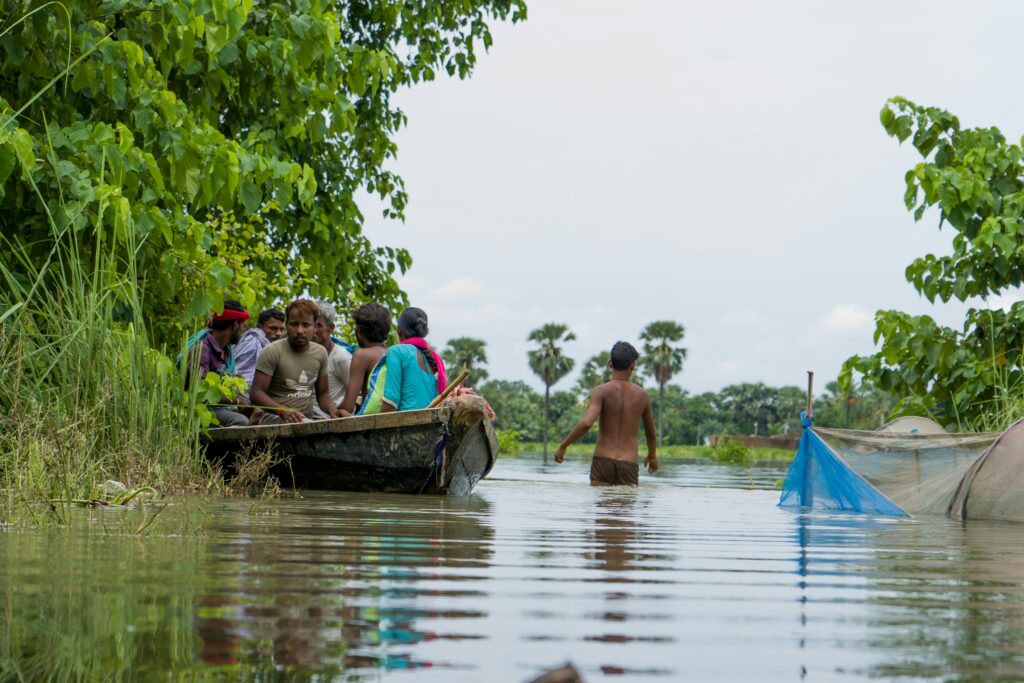
Bangladesh's Water Development Board (BWDB), the national hydrological agency, partnered with Google Research from 2020 to layer an AI/machine-learning flood-inundation model on top of BWDB's own gauge readings and forecasts, extending flood prediction into ungauged tributaries of the flood-prone Brahmaputra-Jamuna and Padma river systems. Localized warnings are pushed to residents through Google Search, Maps and Android notifications.
To provide flood early-warning alerts with a lead time of three hours to three days, including in remote basins that lack dense sensor networks.
Google's hybrid hydrologic-hydraulic ML model, described in a March 2024 Nature paper, is combined with BWDB's real-time gauge data and 5-day forecasts. The system expanded from a 2020 pilot covering 36 sub-districts in 14 districts to 55 districts and 99 sub-districts by the 2021 monsoon.
The 2020 pilot sent about 1 million notifications to roughly 300,000 Android users. Between 13-31 August 2021 alone the expanded system sent 2.9 million notifications to 1.5 million unique users, with a 3.5% click-through rate. The underlying model now operates in over 80 countries, reaching an estimated 460 million people globally (a global, not Bangladesh-specific, figure).
Google's own reporting acknowledges low Android penetration in the remote, flood-exposed areas the system most needs to reach, and describes ongoing work to extend alerts via SMS and IVR for feature-phone users. No independent, Bangladesh-specific accuracy evaluation of forecasts against observed flooding has been published.
Implementation detail (cost, timeline, staffing, conditions for success) is not yet available for this practice.
Where this practice's information was retrieved from, and when.
Nigeria
Nigeria's Hydrological Services Agency says it deployed deep-learning models trained on 200+ years of flood data for its 2026 Annual …
Singapore
Singapore's National Environment Agency runs a peer-reviewed machine-learning system that forecasts dengue cases up to three months ahead. In the …
Sierra Leone
Statistics Sierra Leone and the GRID3 partnership use machine-learning building-footprint detection on satellite imagery to map population at 1-hectare resolution, …
Togo
To rush COVID aid to the poorest, Togo used machine learning on satellite imagery and mobile-phone data to target cash …
Open full copilot Grounded in cited practices — always check the sources.