Grey to Green — Sheffield's Retrofit SuDS Scheme Turning a Dual Carriageway into Rain Gardens (UK)
United Kingdom
Sheffield turned a redundant dual carriageway into the UK's largest retrofit SuDS scheme (2014-2022): swales cut peak flow up to …
India · Greater Noida · See the India profile
Evidence: Descriptive / self-reported Top 58% 40/100 · Ask Evidence Copilot about this practice
Samsung funded a 71,000 m² Miyawaki-method forest in Greater Noida (200,000 saplings, from 2019), part of a district plan raising forest cover from 1.5% toward 33%; a smaller pilot showed 'satisfactory' results, though critics flag high costs and unproven survival.
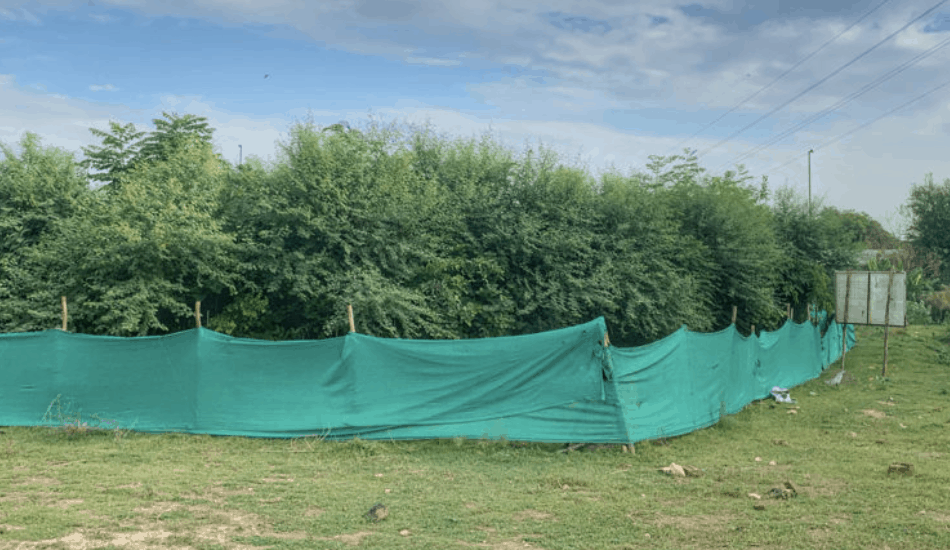
On 11 September 2019 the Gautam Buddh Nagar district administration agreed with Samsung India to develop a 71,000 m² Miyawaki-method forest in Greater Noida, planting roughly 200,000 native saplings under Samsung's CSR programme, with Samsung funding maintenance for 10 years. Officials called it potentially India's largest Miyawaki forest, part of a wider district goal of raising forest cover from about 1.5% toward India's 33% target.
The district had already tested the method on a smaller 3,500 m² plot at its Collectorate compound, reporting 'satisfactory' growth, before committing to the much larger site.
Comparable Miyawaki plantings elsewhere in India offer supporting evidence: a 750 m² plot at Barapullah, Delhi (2,278 trees, 44 native species) showed strong early growth, and published field studies on south Indian Miyawaki stands have measured real biomass and carbon accumulation, with height growth reported roughly 30% faster than conventional afforestation in some comparisons. No site-specific survival-rate or carbon-sequestration data for the Greater Noida plot itself were found in the sources reviewed.
Costs for the wider Miyawaki movement in Indian cities run roughly ₹50,000-60,000 per 100 m² (pushed higher by sapling supply-chain pressures), and ecologists warn dense single-technique planting cannot substitute for protecting existing native forest — real caveats alongside the district's 10-year funded maintenance commitment.
Philanthropic / foundation funding
Indicative funding routes for practices of this type — always check each programme's current calls and eligibility rules.
Do you run this practice? Claim it — verified implementers get a public contact pathway and can propose corrections.
Where this practice's information was retrieved from, and when.
United Kingdom
Sheffield turned a redundant dual carriageway into the UK's largest retrofit SuDS scheme (2014-2022): swales cut peak flow up to …
India
Pallikaranai Marsh, a 1,247-hectare Ramsar wetland (designated 2022) in Chennai, buffers monsoon floods for the city's south and hosts 120+ …
Singapore
Singapore's national tree-planting programme, run by NParks under the Green Plan 2030, had planted over 832,000 of a targeted 1 …
Singapore
PUB and NParks turned a 2.7 km concrete canal carrying the Kallang River into a 3 km naturalised, meandering river …
Open full copilot Grounded in cited practices — always check the sources.