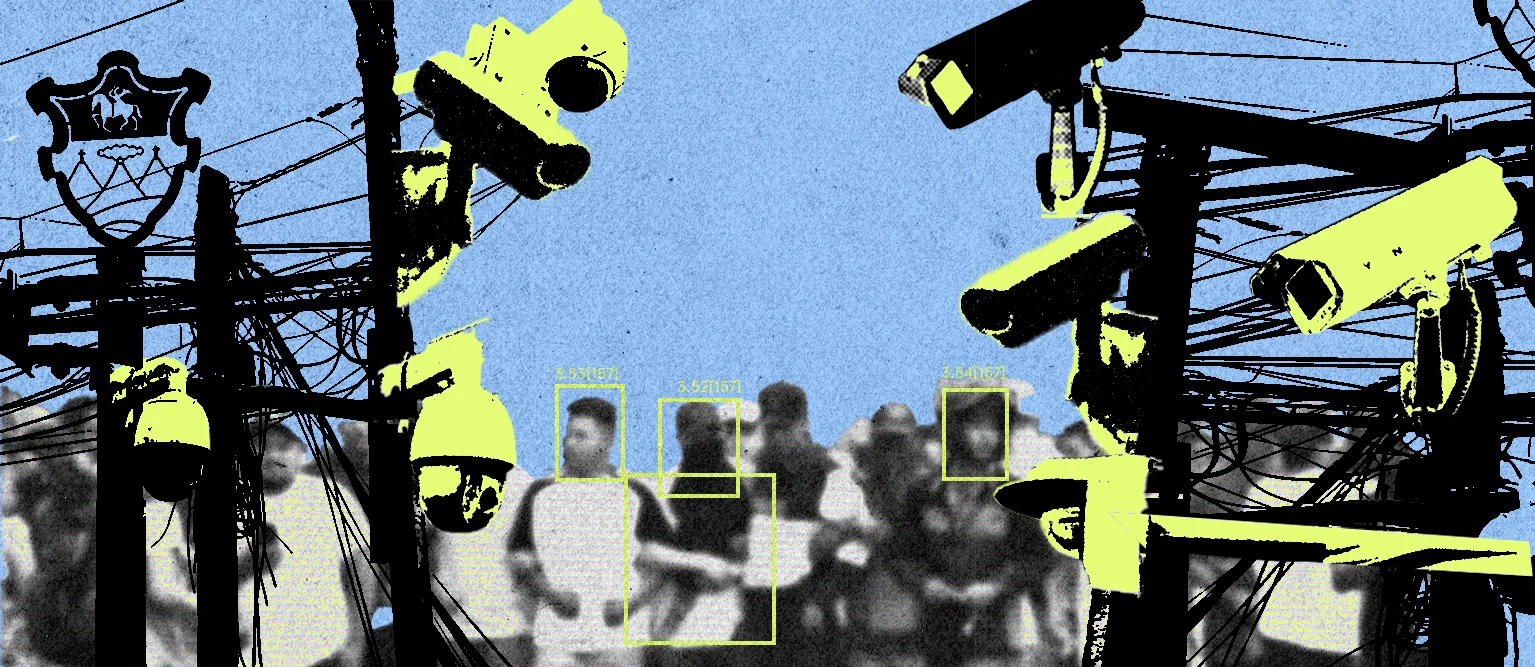
Guatemalan public institutions have built up an AI-enabled camera network with facial recognition for more than a decade, largely outside any dedicated legal framework. The earliest documented deployment dates to June 2014, when Guatemala City installed approximately 1,900 cameras, about 10% of them carrying facial-recognition capability linked to the RENAP national identity database, at a reported cost of $150 million; a Deputy Minister at the time claimed the system cut violence by up to 40% in monitored sectors, a figure that has never been independently audited.
A 2026 investigative analysis of public procurement records by the Guatemalan nonprofit newsroom Agencia Ocote found that, between 2022 and 2026, Guatemalan public institutions — overwhelmingly municipalities, led by Guatemala City — awarded at least Q69,940,405 (about $9.1 million) across 122 contracts for AI video-surveillance and facial-recognition services. Ninety-one percent of that spending was awarded through direct purchase rather than competitive tender. Guatemala City's municipality accounted for 52.9% of the total spend, including a facial-recognition upgrade for 50 cameras at its C4 monitoring center (October 2025, Q89,849.76) and a further facial-recognition services contract (March 2026, Q89,900). Guatemala's public Universidad de San Carlos separately deployed more than 40 facial-recognition cameras across its campuses between 2023 and 2024.
Guatemala has no personal-data-protection law and no permitting regime governing the installation of surveillance cameras. Agencia Ocote's review found that a March 2026 municipal contract listed 'crowd and demonstration detection' among the advertised functions of the system, and identified no published human-rights impact assessment for any of the 122 contracts reviewed.
This practice is included as a documented cautionary case: real, sustained, and geographically widespread AI-surveillance procurement, evidenced by public spending records, proceeding for over a decade with no independent outcome evaluation and no corresponding governance framework.
Read the full analysis: https://www.agenciaocote.com/blog/2026/07/08/ia-videovigilancia-control/
Where this practice's information was retrieved from, and when.