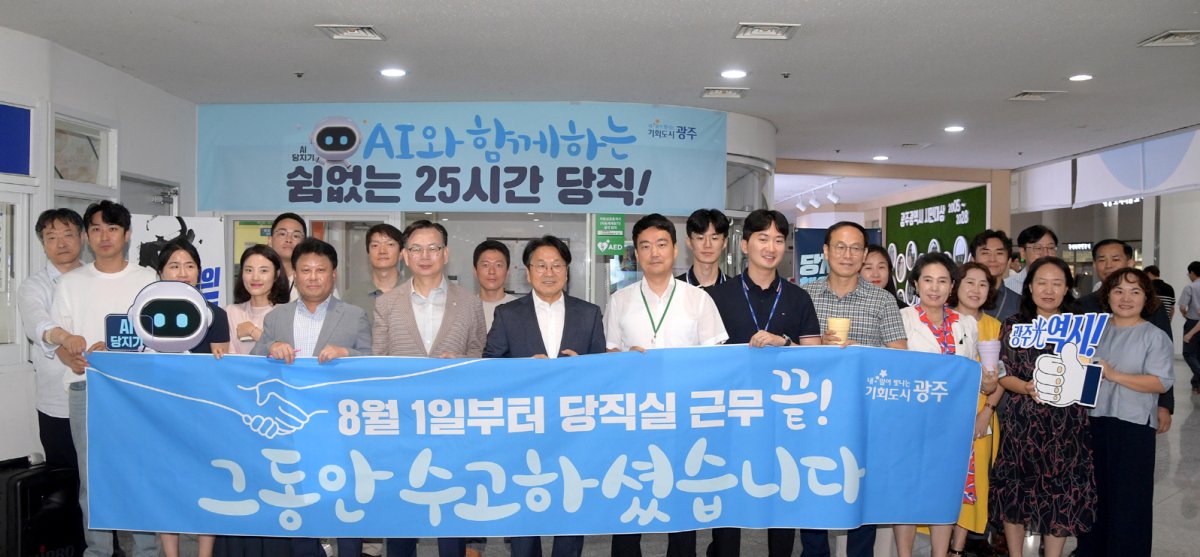
Gwangju's 'AI Dangjigi' has handled complaint calls after-hours since Aug 2024, resolving 86% of 21,648 calls by June 2025 (up from 84% of 9,853 by Feb 2025) and cutting staff duty shifts that once required ~122 employees monthly, per two independent Korean news outlets.
122 employees/month
Monthly staff shifts replaced by the AI duty officer (pre-August 2024)
9,853 calls
Calls received (first 7 months) (Aug 2024–Feb 2025)
84 %
Independent resolution rate (7 months) (Feb 2025)
20 calls/day
Daily staff-handled complaint calls, before the system (pre-Aug 2024)
8 calls/day
Daily staff-handled complaint calls, after the system (Feb 2025)
21,648 calls
Cumulative calls received (first 11 months) (Aug 2024–Jun 2025)
citizen services, generative AI, public administration staffing
Context
In August 2024, Gwangju Metropolitan City replaced its traditional civil-servant duty-rotation system — which required roughly 122 employees each month to staff overnight and holiday shifts — with 'AI Dangjigi' ('AI Duty Officer'), an AI system that answers citizens' after-hours complaint calls, classifies them, and either resolves routine queries directly or routes the call to the relevant department.
Activities
Two independent progress reports tracked its performance over time: Newsis reported on the system's first seven months (to February 2025) and the Financial News (fnnews.com) reported on its first eleven months (to June 2025).
Results
As of February 2025, the system had received 9,853 calls and handled 84% independently (768 public-transit complaints and 5,941 simple inquiries resolved directly, 1,563 transferred to departments), and the daily average of complaint calls needing staff attention fell from 20 to 8. By June 2025, cumulative volume had grown to 21,648 calls with an 86% resolution rate (18,540 calls), including 1,168 transit complaints and 14,899 simple inquiries, with 2,473 calls transferred to five district offices, the water authority, the disaster safety centre and the construction department. Mayor Kang Ki-jung credited the system with resolving the staffing gaps created by compensatory time off after duty shifts and improving response consistency. The reporting is city-sourced rather than independently audited, and does not disclose citizen satisfaction, error rates, or the AI system's own operating costs.
Implementation
Indicative cost
Low (< €50k)
Time to results
Short (< 1 year) — Launched August 2024; progress tracked at 7 months (Feb 2025) and 11 months (Jun 2025), continuing to operate.
Staffing & skills
Gwangju Metropolitan City (implementing government body), Mayor Kang Ki-jung (public sponsor), Five district offices, the water authority, the disaster safety centre and the construction department — recipients of transferred calls
Conditions for success
AI classifies calls and either resolves routine queries directly or routes them to the correct department
Clear escalation pathway to five district offices and specialist departments for complex complaints
Continuous progress tracking and public reporting of call volumes and resolution rates over successive periods
Common failure modes
City-sourced reporting only, not independently audited
No citizen satisfaction, error-rate, or AI operating-cost data disclosed
Where it fits
Governance type
metropolitan city government
Scale
city-wide (Gwangju)
Income level
high income (South Korea)
Commonly funded by
Own resources / municipal budget
Indicative funding routes for practices of this type — always check each programme's current calls and eligibility rules.
Do you run this practice?
Claim it —
verified implementers get a public contact pathway and can propose corrections.
Data sources
Where this practice's information was retrieved from, and when.
Baden-Württemberg built F13, the first AI assistant in productive use across a full German state administration, running on sovereign infrastructure; …