Digital Inclusion for Women's Economic Empowerment (D4WEE) – Women's Digital Centers
Liberia
UN Women and the Orange Foundation built Women's Digital Centers at Peace Huts in rural Bong County, Liberia; 45 women …
Bangladesh · Dhaka · See the Bangladesh profile
D.Net's Infolady model trains rural Bangladeshi women as bicycle-riding info-entrepreneurs delivering health, agriculture and e-government services door-to-door; it reached roughly 300 villages and 50,000 households weekly, later scaling via a dedicated social enterprise.
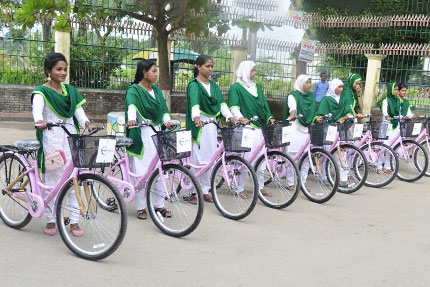
In rural Bangladesh, where fixed-line and early internet infrastructure bypassed most villages and cultural norms limited women's mobility and access to information, the NGO D.Net (Development Research Network) piloted the 'Infolady' model from the mid-2000s. Young rural women are trained and equipped with a bicycle, laptop, webcam and internet modem, then travel door-to-door offering services for a small fee.
The model set out to bring health, agricultural, e-government and communication services to villages with no local access point, while creating a self-sustaining livelihood for women info-entrepreneurs.
Infoladies offer health consultations via video link, agricultural advice, e-government services, video calls for migrant workers' families, and digital literacy support, charging small per-service fees.
By roughly a decade in, more than 50 trained Infoladies across six districts were together covering close to 300 villages, with individual Infoladies each visiting 15 to 20 villages a week and the network cumulatively reaching an estimated 50,000 households. Independent field reporting from Al Jazeera and France 24, alongside D.Net's own monitoring, found Infoladies earning roughly $60 to $175 a month — a meaningful income in their communities — while a structured evaluation rated the model 6.9 out of 10 on women's empowerment and 6.4 out of 10 on community acceptance.
D.Net subsequently spun the model into a dedicated entity, Infolady Social Enterprise Limited, with an explicit goal of scaling to around 10,000 Infoladies nationally. As with many fee-for-service models, sustained income depends on population density and competing free alternatives such as spreading smartphone ownership, which case studies flag as a long-term viability question.
Implementation detail (cost, timeline, staffing, conditions for success) is not yet available for this practice.
Where this practice's information was retrieved from, and when.
Liberia
UN Women and the Orange Foundation built Women's Digital Centers at Peace Huts in rural Bong County, Liberia; 45 women …
Lesotho
A $7.1M World Bank/GPE-financed project gave Lesotho teachers tech-enabled training and ran youth clubs in junior secondary schools, reaching 40,569 …
Taiwan
Taiwan's Ministry of Education has built 300 Digital Opportunity Centers in 168 remote/indigenous villages since 2005 (NT$6.8bn/US$212m in phase one), …
China
Bottom-up rural e-commerce clusters on Alibaba's Taobao platform, reinforced by Alibaba's top-down Rural Taobao service-station network, grew from 3 villages …
Open full copilot Grounded in cited practices — always check the sources.