Internet Saathi — Women-Led Digital Literacy Network, India
India
Tata Trusts and Google India's Internet Saathi programme trained close to 60,000 rural women as digital-literacy trainers ('saathis'), reaching over …
Bangladesh · Dhaka · See the Bangladesh profile
D.Net's InfoLady (Kallyani) model trains rural Bangladeshi women as bicycle-riding info-entrepreneurs who deliver ICT-enabled health, agriculture, finance and government-service information door-to-door. 464 Kallyanis operated across 9 districts by 2018.
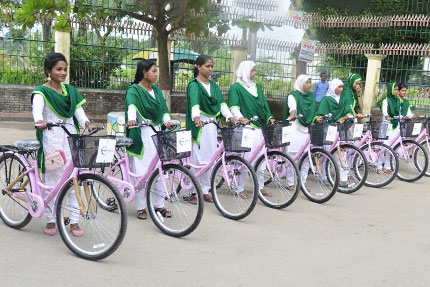
D.Net (Development Research Network), a Bangladeshi social enterprise, piloted the InfoLady concept from 2004 and formalised it as the 'Kallyani' business model in 2010 — a women-for-women info-preneurship approach to last-mile ICT access in rural Bangladesh.
Enable rural women, financed through micro-loans, to deliver door-to-door ICT-enabled health, agricultural, government-service and communication information to households, including on culturally sensitive topics such as contraception.
Each Kallyani is equipped with a tablet/smartphone, laptop, camera and bicycle (financed via a ~70,000-80,000 BDT bank micro-loan), covering a catchment of ~3-4 sq km / 400 households and charging small per-service fees (US$0.13-US$1.30).
By 2018, 464 Kallyanis were active across 9 districts. An earlier cohort of 102 Kallyanis completed over 500,000 paid service transactions (2010-2015), with providers reporting average monthly earnings of $100-150. A 2015 interim qualitative evaluation recorded client satisfaction of 8/10 and trust in the Kallyani of 9/10; scale fell well short of D.Net's stated ambition of 10,000 Kallyanis nationwide by 2021.
Implementation detail (cost, timeline, staffing, conditions for success) is not yet available for this practice.
Where this practice's information was retrieved from, and when.
India
Tata Trusts and Google India's Internet Saathi programme trained close to 60,000 rural women as digital-literacy trainers ('saathis'), reaching over …
Rwanda
Rwanda's government-led Digital Ambassadors Program trains young digital ambassadors, 51% of them women, to deliver community digital-literacy training nationwide. Over …
Finland
Finland is actively engaged in promoting gender equality through digitalization as part of the Generation Equality campaign. The country's leadership …
Nepal
In Nepal's Kailali and Doti districts, Restless Development and UN Women ran a 2015–2017 peer-education programme against chhaupadi menstrual exile …
Open full copilot Grounded in cited practices — always check the sources.