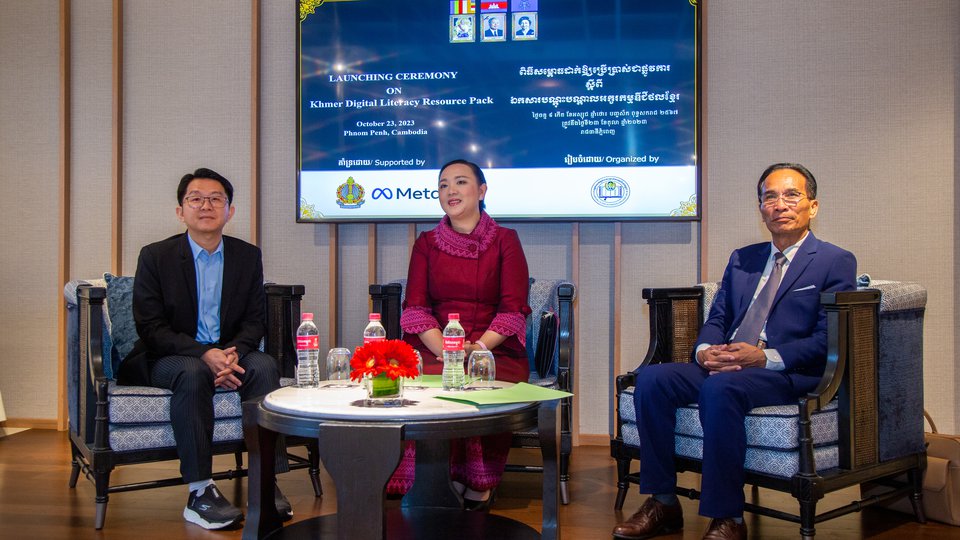
Cambodia's MoEYS, Meta, and KAPE localised Meta's WeThinkDigital curriculum in Khmer for secondary schools. Piloted 2022–2023 in 6 New Generation Schools with 12 Master Trainers, targeting 3,000–5,000 students; MoEYS officially adopted the curriculum for national use in 2024.
6 schools
New Generation Schools in pilot (2022–2023)
12 trainers
Master Trainers trained (2022–2023)
3,000–5,000 students
Target students (2022–2023 pilot)
Details
Maturity
Scaling
Promoter
Ministry of Education, Youth and Sport (MoEYS) / KAPE / Meta
Period
2022–2024
Keywords
government, education, NGO, private sector, digital literacy
Context
Cambodia's Digital Economy and Social Policy Framework 2021-2035 acknowledges that only around 30% of the population possess foundational digital skills, the backdrop for a government-civil society-private sector partnership between the Ministry of Education, Youth and Sport (MoEYS), Kampuchea Action to Promote Education (KAPE) and Meta, with technical support from Kawsang (InSTEED iLabSEA).
Objectives
The Khmer Digital Literacy Programme (KDLP) aims to localise Meta's WeThinkDigital digital-literacy curriculum into Khmer and adapt it to the Cambodian secondary-school context, covering critical thinking online, privacy and security, digital communication and responsible social media use.
Activities
The programme piloted from October 2022 to September 2023 in six New Generation Schools (NGS), with 12 Master Trainers recruited and trained through a Train-of-Trainers workshop, targeting 3,000-5,000 secondary students. The pilot was intentionally small-scale to allow iterative refinement of the contextualised curriculum.
Results
Following the pilot, MoEYS officially adopted the KDLP curriculum for national use in Cambodian schools in 2024, embedding structured digital literacy into the formal secondary education system and reaching all New Generation Schools and beyond.
Implementation
Indicative cost
Medium (€50k–€500k)
Time to results
Medium (1–3 years) — Piloted October 2022–September 2023; MoEYS adopted the curriculum for national use in 2024.
Staffing & skills
12 Master Trainers (Train-of-Trainers cascade model), MoEYS, KAPE and Meta programme teams, Technical support from Kawsang (InSTEED iLabSEA)
Conditions for success
Cross-sector partnership spanning government (MoEYS), NGO (KAPE), and private sector (Meta)
Deliberately small-scale pilot (6 schools) to allow iterative curriculum refinement before national rollout
Localisation of an existing global curriculum (WeThinkDigital) into Khmer rather than building from scratch
Formal Train-of-Trainers cascade model for scaling delivery capacity
Where it fits
Governance type
government-led with NGO and private-sector partners
Scale
pilot (6 schools) transitioning to national (all New Generation Schools and beyond)
Income level
lower-middle income country
Commonly funded by
National / regional programmes
Indicative funding routes for practices of this type — always check each programme's current calls and eligibility rules.
Do you run this practice?
Claim it —
verified implementers get a public contact pathway and can propose corrections.
Data sources
Where this practice's information was retrieved from, and when.
Solar-powered, offline tablets deliver adaptive literacy and numeracy lessons in rural Sierra Leone schools, partnered with the Ministry of Education …
OLE Nepal deploys offline digital libraries (E-Pustakalaya) and interactive learning software (E-Paath) on local servers in remote Nepali schools without …