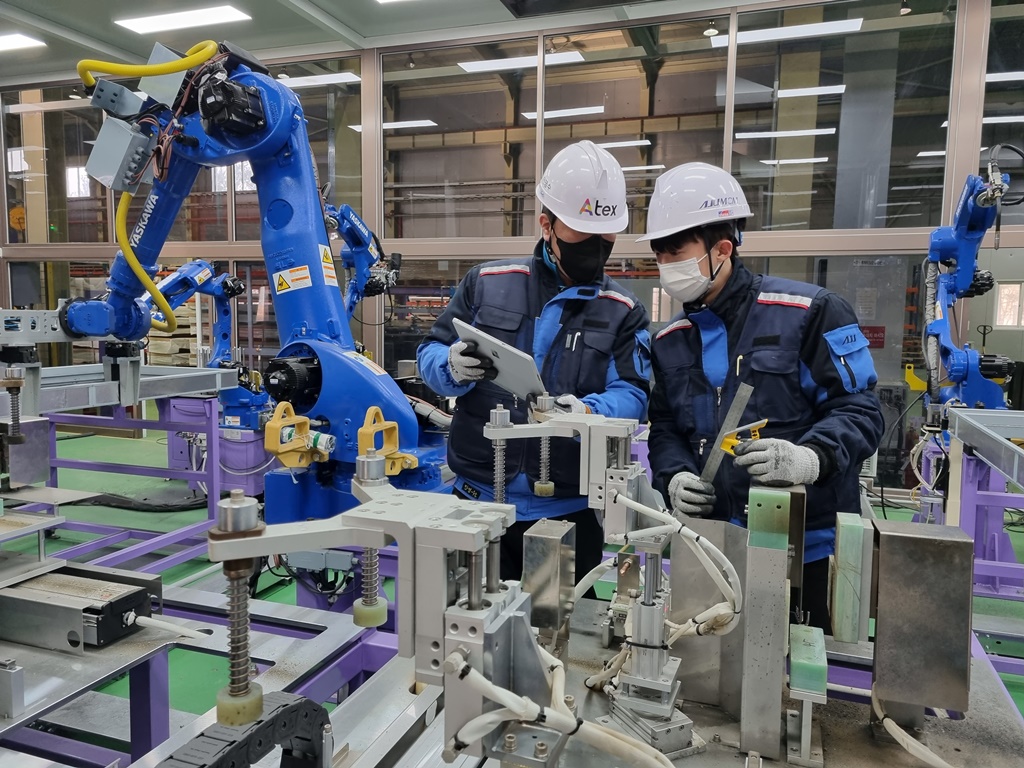
Since 2014 South Korea's Ministry of SMEs and Startups has subsidised smart-factory conversions for SMEs. Government survey data and an independent matched-sample study both report double-digit productivity gains, though reviews find effects concentrate at the process level.
28.5%
Productivity gain (government survey)
29%
Productivity gain (independent PSM study) (2019-2020 cohort, 1 year after conversion)
-35.2%
Unit cost reduction (independent PSM study) (2019-2020 cohort)
24,000+
Manufacturing SMEs supported
Details
Maturity
Established
Promoter
Ministry of SMEs and Startups (Korea Smart Manufacturing Office / KOSMO)
Period
2014-present
Keywords
manufacturing, industry 4.0, automation, smart factory, SME productivity
Context
Launched in 2014 by South Korea's Ministry of SMEs and Startups and administered through the Korea Smart Manufacturing Office (KOSMO), the Smart Factory programme co-funds adoption of IoT, data-collection, automation and AI tools by manufacturing SMEs, tiered from basic digitisation to advanced smart-factory conversion.
Activities
Support has reached more than 24,000 manufacturing SMEs across over 32,000 projects.
Results
Government survey data (Ministry of SMEs and Startups, via a Korea Federation of SMEs poll of converted firms) reports average production-cost cuts of 15.5%, productivity gains of 28.5%, quality improvements of 42.5%, about 2.6 additional employees per firm and a 6.2% reduction in industrial accidents; 15.1% of surveyed firms reported increased employment after conversion. An independent, peer-reviewed evaluation using propensity-score matching on more than 7,000 SMEs that completed conversion in 2019-2020 corroborates the direction and scale of these effects — +29% productivity, +42.1% quality, -35.2% unit costs, +11.3% sales and +2.1 full-time-equivalent jobs per firm one year after implementation.
Conclusions
Other academic reviews of the same policy family caution that measured gains cluster at the process level (defect rates, lead times, unit costs) and that effects on broader firm profitability are harder to detect within short observation windows of roughly two years. Reshoring cases such as Aju Steel Co. illustrate the qualitative story but are anecdotal rather than representative.
Implementation
Indicative cost
High (€500k–€5M)
Time to results
Long (> 3 years)
Staffing & skills
Ministry of SMEs and Startups officials, Korea Smart Manufacturing Office (KOSMO) administrators, private automation/IT vendors, Korea Federation of SMEs (outcome surveys)
Conditions for success
tiered co-funding matched to SME capability (basic to advanced conversion)
an established vendor ecosystem for IoT/automation/AI tools
government survey infrastructure to track outcomes post-conversion
Common failure modes
measured gains concentrate at the process level (defect rates, lead times, unit costs) rather than broader firm profitability
short observation windows (~2 years) limit visibility into durability of gains
Where it fits
Governance type
national government subsidy programme
Scale
national, tens of thousands of SMEs
Income level
high-income
Commonly funded by
National / regional programmes
Indicative funding routes for practices of this type — always check each programme's current calls and eligibility rules.
Do you run this practice?
Claim it —
verified implementers get a public contact pathway and can propose corrections.
Data sources
Where this practice's information was retrieved from, and when.
South Korea's long-running national scheme co-finances manufacturing SMEs to install smart-factory systems — automation, data and process control; independent trade …
With JICA support, Ethiopia built a standing government institute to disseminate Japanese-style Kaizen management; from 2012/13-2016/17 it trained nearly 69,000 …