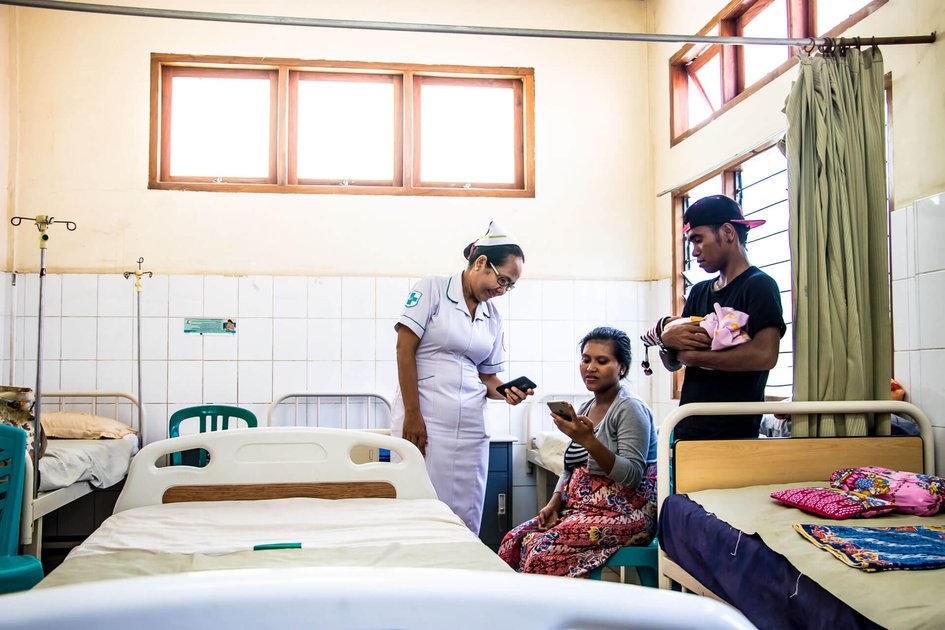
Liga Inan pairs pregnant women in Timor-Leste with SMS/voice check-ins and community health volunteers via mobile phone. A peer-reviewed evaluation found large gains in skilled birth attendance and postnatal checks after the Ministry of Health adopted it nationally.
1.9 OR
Skilled birth attendance (odds ratio)
1.9 OR
Facility-based delivery (odds ratio)
4.7 OR
Postpartum care within two days (odds ratio)
5.5 OR
Newborn postnatal checks within two days (odds ratio)
60000
Mothers enrolled (cumulative, by 2020) (by 2020)
64 %
Women identifying Liga Inan as primary source of maternal health information
Details
Maturity
Established
Promoter
Health Alliance International / Catalpa International (with Timor-Leste Ministry of Health)
Period
2013–present
Keywords
maternal health, mHealth, telemedicine, digital inclusion
Context
Liga Inan ('Connecting Mothers') is a mobile-phone maternal and newborn health service launched in 2013 in Timor-Leste by Health Alliance International (now Hamutuk Nasaun Saudavel) and Catalpa International, in partnership with the Ministry of Health, in a country with low fixed connectivity and dispersed rural populations.
Objectives
The service aims to extend maternal-health information and follow-up to pregnant women and at-risk mothers over basic mobile channels rather than fixed internet infrastructure.
Activities
Enrolled pregnant women receive SMS and voice messages timed to their pregnancy stage, while community health volunteers use the same system to track and follow up with at-risk mothers.
Results
A quasi-experimental evaluation (Journal of Global Health, 2019, University of Washington authors) compared an intervention district (Manufahi) with a control district (Ainaro) using baseline (2012, n=581) and endline (2015, n=576) surveys. It found skilled birth attendance and facility-based delivery each nearly doubled (OR 1.9), postpartum care within two days rose roughly five-fold (OR 4.7), and newborn postnatal checks within two days rose over five-fold (OR 5.5); no significant effect was found on antenatal care visit frequency. The Ministry of Health formally adopted Liga Inan as national policy, and by 2020 enrolment had reached its 60,000th mother. Timor-Leste's National Health Institute separately found 64% of surveyed women identified Liga Inan as their primary source of maternal health information.
Conclusions
The evaluation's own authors note that its quasi-experimental, non-randomised design limits causal certainty, and the lack of an antenatal-visit effect suggests the programme worked better for delivery and postnatal behaviours than for visit frequency. As an mHealth service rather than a general digital-literacy programme, its digital-inclusion contribution is specifically about extending health information access over basic mobile channels in a low-connectivity setting.
Implementation
Indicative cost
High (€500k–€5M) — No specific budget figures are disclosed in the source material; conservatively banded high given a national, multi-year mHealth deployment with formal government partnership and adoption.
Time to results
Long (> 3 years) — Launched 2013, formally adopted as national policy by the Ministry of Health, and still running as of the most recent (2020) enrolment reporting — over a decade of continuous operation.
Staffing & skills
Health Alliance International / Hamutuk Nasaun Saudavel field staff, Catalpa International technical/SMS platform team, Community health volunteers, Timor-Leste Ministry of Health staff
Conditions for success
Partnership between an international NGO, a technology provider and the national Ministry of Health
Leveraging existing basic mobile phone penetration in a low fixed-connectivity setting
Messages timed to pregnancy stage combined with volunteer follow-up for at-risk mothers
Common failure modes
No measurable effect on antenatal care visit frequency, suggesting messaging alone does not shift every maternal-health behaviour
Where it fits
Governance type
government-adopted national policy delivered via NGO/tech partnership
Scale
national (Timor-Leste)
Income level
low-income, low fixed-connectivity, dispersed rural population
Commonly funded by
National / regional programmes
Indicative funding routes for practices of this type — always check each programme's current calls and eligibility rules.
Do you run this practice?
Claim it —
verified implementers get a public contact pathway and can propose corrections.
Data sources
Where this practice's information was retrieved from, and when.