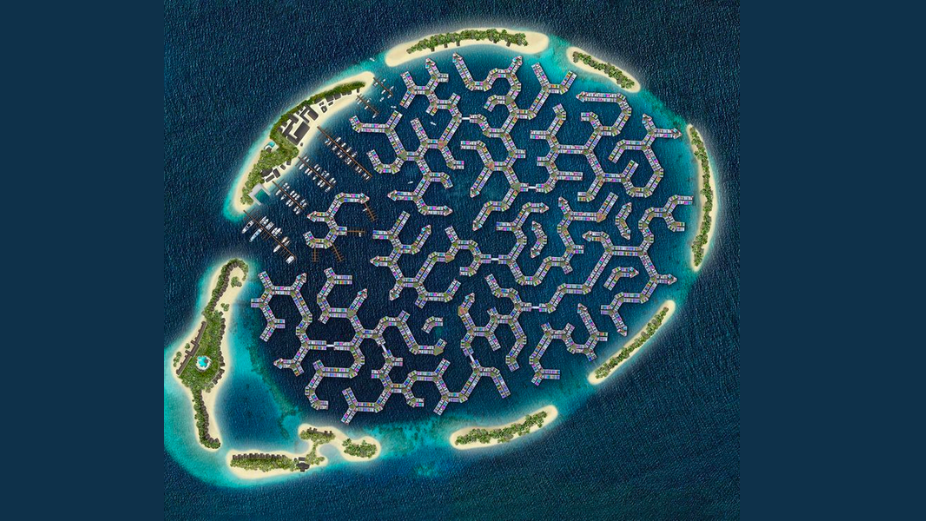
A 5,000-unit floating city planned for a Malé lagoon to demonstrate flood-proof urbanism — but its 2027 completion target has slipped with no verified delivery data, and Maldives' own government has publicly alleged the developer resold free-granted lagoons.
5,000 units
Planned floating housing, retail and civic units (design target, not confirmed as delivered)
Details
Promoter
Dutch Docklands / Waterstudio, with the Government of Maldives
Period
2021–ongoing (delayed)
Keywords
climate adaptation, urban experimentation, real estate development, marine engineering
Context
Maldives Floating City is a planned settlement of roughly 5,000 floating housing, retail and civic units in a lagoon near the capital Malé, developed by the Dutch firm Dutch Docklands with architecture practice Waterstudio and the Government of Maldives under an 'Integrated Tourism Model' permit.
Objectives
The units are designed to be tethered to the lagoon floor and arranged in a canal pattern, intended as a demonstration of floating urbanism as a response to sea-level rise.
Activities
The government granted final approvals in June 2022, with an initial demonstration block originally targeted for August 2022, full modular construction planned from January 2023, and completion of the wider project projected for around 2027.
Results
Public sources report no independently verified figures on units completed, residents relocated, or capital deployed since that timeline was set, and the project has become mired in domestic controversy after Maldives' Economic Minister told parliament the developer had resold lagoons that were originally granted free of charge, an allegation one member of parliament called a serious crime, with no independent audit or resolution found in available sources.
Conclusions
Because verified delivery data is absent and the project's governance has been publicly disputed by government officials themselves, it stands as a genuinely novel engineering and urban-design concept whose real-world evidence base on cost, equity and even basic project integrity remains unproven.
Implementation
Indicative cost
Very high (> €5M)
Time to results
Long (> 3 years)
Staffing & skills
Dutch Docklands (developer), Waterstudio (architecture), Government of Maldives (permits and lagoon grant)
Conditions for success
Formal 'Integrated Tourism Model' permit partnership between the developer and the Government of Maldives
Common failure modes
No independently verified progress reported since the 2022 approvals
Completion timeline delayed to around 2027
Public allegation that the developer resold free-granted lagoons, without independent audit or resolution
Do you run this practice?
Claim it —
verified implementers get a public contact pathway and can propose corrections.
Data sources
Where this practice's information was retrieved from, and when.
Belgrade's CEUS and city Environmental Protection Secretariat built the Western Balkans' first Urban Living Lab, ratifying a 60-member, 35-institution Partnership …