Barrios Vitales — Bogotá's San Felipe Pilot Cuts Traffic Injuries by Nearly Half
Colombia
Bogotá's first 'vital neighbourhood', San Felipe, reallocated 1,745 m² of street space to pedestrians and cut traffic accidents 46%; the …
Colombia · Medellín · See the Colombia profile · See the Medellín profile
Evidence: Observational / pre–post Top 1% 95/100 · Ask Evidence Copilot about this practice
Medellín integrated cable-car lines and hillside escalators with neighbourhood upgrading to connect its poorest comunas to the city, cutting homicide rates 97% (395→13 per 100,000) from 1991 to 2023 and inspiring cable-car transit programmes worldwide.
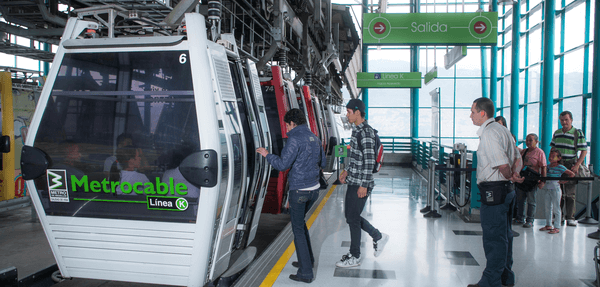
Between 2004 and 2019 (and continuing to the present), Medellin's poorest hillside comunas were steep, informally settled, and disconnected from the city's transit network and economic opportunities, with the city recording a homicide rate that had peaked at 395 per 100,000 in 1991.
Use transit and small-scale infrastructure interventions ('urban acupuncture') as levers for social equity and violence reduction, not just mobility, to connect the poorest comunas to the wider city.
The flagship Metrocable Line K (2004) linked the steep hillside comunas to the Metro network, reducing travel time from two hours to 30 minutes. In 2011 the city added outdoor escalators in Commune 13 alongside public libraries, cultural spaces (Unidades de Vida Articulada, UVAs), outdoor lighting and micro-enterprise programmes. The system now comprises five cable-car lines carrying roughly 136,000 daily passengers.
The homicide rate fell from a peak of 395 per 100,000 in 1991 to 13 per 100,000 in 2023 -- a 97% reduction documented by Medellin's official SISC security data. A 2016 ScienceDirect peer-reviewed analysis found areas served by Line K experienced statistically significant crime reductions. Medellin's Metrocable holds a Guinness World Record as the world's busiest public-transit aerial cable car, and the approach is documented by UN-Habitat and the World Bank as a replicable model.
The programme is not without caveats: Line J did not achieve the same social outcomes as Line K, and violence rebounded in some areas in later years, underscoring that infrastructure alone is insufficient without broader security and social investment. The integrated model -- transit + culture + economic opportunity -- remains the most-cited example of urban equity intervention in the Global South, and has been replicated in Caracas, La Paz, Bogota and Rio de Janeiro.
National / regional programmes
Indicative funding routes for practices of this type — always check each programme's current calls and eligibility rules.
Do you run this practice? Claim it — verified implementers get a public contact pathway and can propose corrections.
Where this practice's information was retrieved from, and when.
Documented replications and adaptations of this practice elsewhere.
| Place | When | Adopter | Outcome |
|---|---|---|---|
| Caracas, Venezuela | — | Municipal cable-car transit programme | Replicated Medellin's aerial cable-car social-urbanism model to connect hillside neighbourhoods to the city |
| La Paz, Bolivia | — | Municipal cable-car transit programme | Replicated Medellin's aerial cable-car social-urbanism model to connect hillside neighbourhoods to the city |
| Bogota, Colombia | — | Municipal cable-car transit programme | Replicated Medellin's aerial cable-car social-urbanism model to connect hillside neighbourhoods to the city |
| Rio de Janeiro, Brazil | — | Municipal cable-car transit programme | Replicated Medellin's aerial cable-car social-urbanism model to connect a hillside favela to the city |
Colombia
Bogotá's first 'vital neighbourhood', San Felipe, reallocated 1,745 m² of street space to pedestrians and cut traffic accidents 46%; the …
South Africa
A 'second-generation' crime-prevention-through-design programme in Cape Town's Khayelitsha township pairs infrastructure upgrading with community safety work; a peer-reviewed 2020 study …
Sweden
Stockholm trialled a cordon congestion charge from January to July 2006 alongside new bus services, cut inner-city rush-hour traffic by …
Kenya
A university-NGO consortium GPS-mapped Nairobi's ~130 informal matatu routes and 3,000+ stops, producing the first standardised (GTFS) map of an …
Open full copilot Grounded in cited practices — always check the sources.