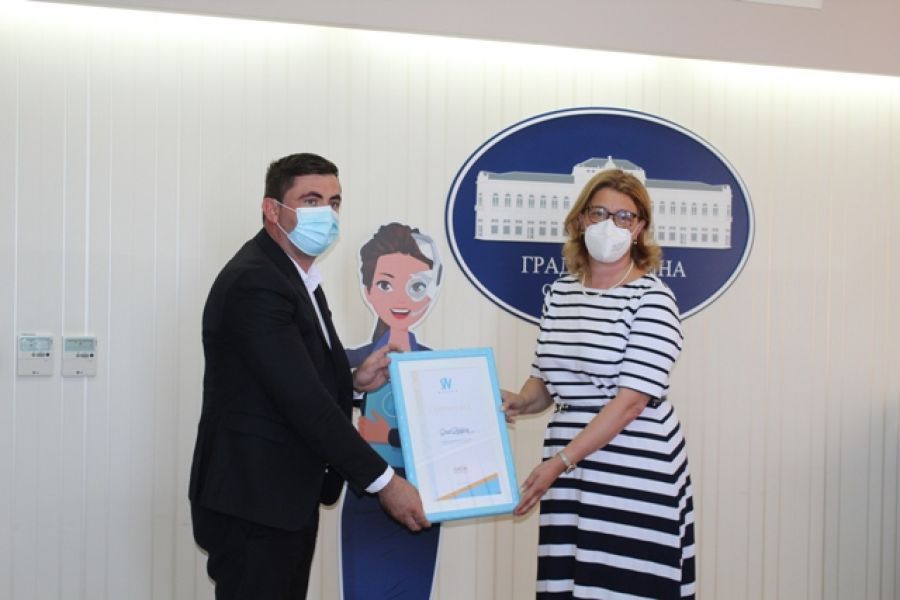
Bijeljina and Laktaši, in Republika Srpska, deployed MIA, a Viber/web AI assistant for marriage records, business registration and scholarships — part of a German-funded regional programme reaching ~80,000 users across four municipalities.
~80,000
Registered users (four-municipality programme) (~1 year after launch)
140,000+
Total conversations (four-municipality programme) (~1 year after launch)
298
Utility-related reports filed via chatbot (3-month window after 2022 upgrade)
181
Vital-records/certificate requests filed via chatbot (3-month window after 2022 upgrade)
up to 2,400 hours/year
Staff hours spent annually on routine queries before chatbot (estimate)
Details
Maturity
Established
Promoter
City Administration of Bijeljina and Municipality of Laktaši (Republika Srpska, Bosnia and Herzegovina), with SAGA, GIZ/BMZ (develoPPP.de), NALED and the Chamber of Commerce of Republika Srpska
Period
2021–
Keywords
e-government, municipal services, chatbot, civil registry, Viber
Context
In October 2021, the cities of Bijeljina and Laktaši, in Bosnia and Herzegovina's Republika Srpska, became the first BiH municipalities to deploy MIA (Municipal Intelligent Assistant), an AI chatbot available on Viber, the cities' web portals and Facebook Messenger. It was introduced under a regional programme funded through Germany's develoPPP.de programme (GIZ, on behalf of BMZ) and implemented with software company SAGA, the Chamber of Commerce of Republika Srpska and business-network NGO NALED; the same programme separately deployed MIA in two Serbian municipalities, Šabac and Sombor.
Activities
MIA answers citizens' most common administrative questions — such as marriage-record registration, business/LLC registration procedures, and eligibility for student scholarships — plus general information like office hours and department contacts, available around the clock. According to GIZ, municipal staff across the pilot cities had been spending up to 2,400 hours a year answering these routine queries before the chatbot's introduction.
Results
Independent reporting by NALED put combined usage across all four pilot municipalities (Bijeljina, Laktaši, Šabac and Sombor) at close to 80,000 registered users and more than 140,000 total conversations roughly a year after launch, with 298 utility-related reports and 181 vital-records/certificate requests filed through the chatbot channels in a three-month window after a 2022 software upgrade. These figures are reported at the level of the four-municipality programme rather than broken out for Bijeljina and Laktaši alone.
Conclusions
The City of Bijeljina's own communications described MIA as 'a new employee' of the city administration, reflecting its role in absorbing routine query volume, though city-specific usage in Bosnia and Herzegovina cannot be isolated from the published programme-level data.
Implementation
Indicative cost
Low (< €50k)
Time to results
Medium (1–3 years)
Staffing & skills
City Administration of Bijeljina and Municipality of Laktaši staff, SAGA (software implementation partner), GIZ/BMZ develoPPP.de programme, NALED and Chamber of Commerce of Republika Srpska
Conditions for success
Multi-channel deployment (Viber, web portal, Facebook Messenger) to meet citizens where they already are
Donor co-funding (develoPPP.de) to lower the municipal cost barrier
Defined narrow use cases (marriage records, business registration, scholarships)
Common failure modes
No BiH municipalities beyond Bijeljina and Laktaši adopted MIA since 2021 despite the regional programme's ambitions
No public information on data handling or algorithmic oversight for the chatbot was found
Long-term continuity depends on donor funding rather than a confirmed municipal budget line
Where it fits
Governance type
municipal government with donor-funded regional programme
Scale
two municipalities (part of a four-municipality regional programme)
Income level
upper-middle-income
Do you run this practice?
Claim it —
verified implementers get a public contact pathway and can propose corrections.
Data sources
Where this practice's information was retrieved from, and when.
Bogotá's WhatsApp-based AI assistant Chatico logged 3.6M+ conversations since 2023, handled 1.6M queries during a water-rationing crisis, and carried 147,000+ …