PAM — Uruguay's National Adaptive Maths Platform: CINVE Finds +0.2 SD, Largest for Lower-Income Pupils
Uruguay
Plan Ceibal's adaptive maths platform (PAM) reached about half of Uruguay's grade 3–6 pupils by 2016. A CINVE evaluation estimates …
Gambia · Brikama · See the Gambia profile
Evidence: Descriptive / self-reported Top 81% 33/100 · Ask Evidence Copilot about this practice
A World Bank-backed pilot brought the AI-adaptive platform Mindspark to pre-service teacher training at The Gambia College. A baseline found only 60% of trainees reached minimum proficiency, and female trainees were hesitant to seek help from all-male coaches.
The Gambia's Teacher Competency Assessment (TCA) found that only 60% of graduating pre-service teachers for lower basic education reached minimum subject-matter proficiency, against a backdrop where roughly 90% of the country's 10-year-olds struggle to read and understand a simple passage.
Strengthen trainee teachers' own foundational math and English skills, addressing the teacher-preparation pipeline at its source.
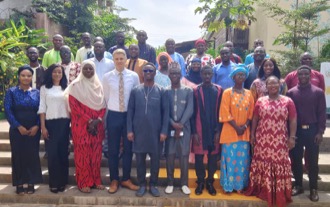
MoHERST, the Ministry of Basic and Secondary Education, The Gambia College and the World Bank piloted Mindspark, an AI-driven adaptive learning platform, with trainee teachers. At an October 2024 forum in Banjul, Gambian officials including the Minister of Higher Education, Professor Pierre Gomez, and World Bank Senior Economist Jason Weaver reviewed the TCA findings and discussed scaling up adaptive learning technologies alongside the government's parallel move to a three-year teacher training programme.
The pilot's own World Bank-published Adaptive Learning Toolkit records an equity finding alongside the diagnostic results: socio-cultural norms significantly affected how female trainees engaged with the software. Female learners were observed to be hesitant to ask questions or request support because of social norms that made them reserved around the pilot's all-male coaches and teachers, which in turn limited their access to help and their effective use of the platform.
As of the reported forum, the pilot had produced a rigorous baseline diagnosis and an honestly documented equity failure mode, but no published pre/post evidence yet shows Mindspark improved trainee teachers' own proficiency scores — this is an instructive early-stage pilot rather than a proven intervention, and the gendered access gap it surfaced is a caution for other single-gender-coached adaptive learning rollouts.
Do you run this practice? Claim it — verified implementers get a public contact pathway and can propose corrections.
Where this practice's information was retrieved from, and when.
Uruguay
Plan Ceibal's adaptive maths platform (PAM) reached about half of Uruguay's grade 3–6 pupils by 2016. A CINVE evaluation estimates …
India
An adaptive learning system rigorously evaluated by MIT's J-PAL: students gained 2–2.5× the control group's progress in maths and language …
Uruguay
National adaptive mathematics platform (PAM) for all Uruguayan primary (grades 3-6) and lower secondary students since 2013. An independent CINVE …
Côte d'Ivoire
A 22-week difference-in-differences evaluation of the EvidenceB adaptive-learning platform at Gagnoa's Technical and Vocational High School found active users gained …
Open full copilot Grounded in cited practices — always check the sources.