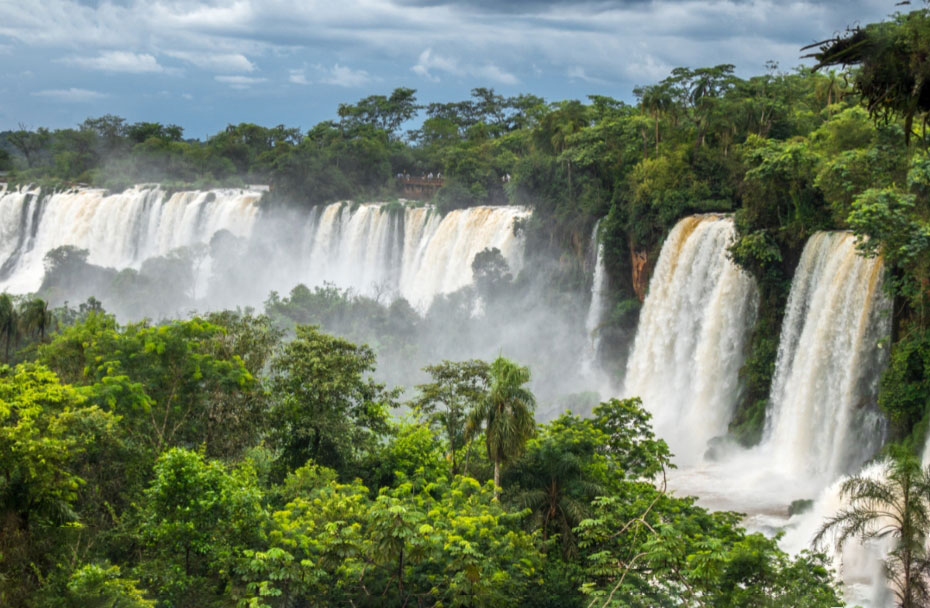
Misiones province registered Argentina's first government-led jurisdictional REDD+ programme under Verra's JNR framework, covering ~1.5M ha of Atlantic Forest and verifying ~10.2M tCO2e in emission reductions (2017–2022), rated A-AA by Sylvera.
Misiones, in northeastern Argentina, contains a large share of the country's remaining Atlantic Forest, one of the most fragmented biodiversity hotspots on Earth, and the provincial government promotes itself as Argentina's only carbon-negative province.
Activities
In 2026 Misiones registered the Misiones Jurisdictional REDD+ Programme with Verra under Scenario 2 of the Verified Carbon Standard's Jurisdictional and Nested REDD+ (JNR) framework, the first government-led, jurisdiction-wide REDD+ programme to be certified in Argentina. Independent validation was carried out by Aenor, and the programme includes a formal mechanism to distribute proceeds back to communities. The province is also pursuing CORSIA-eligible credit sales, including a deal with LATAM Airlines.
Results
The programme verified approximately 10.2 million tCO2e of emission reductions for 2017–2022 across roughly 1.5 million hectares of native forest, and received an A–AA pre-issuance integrity rating from carbon ratings agency Sylvera, among the higher scores given to REDD+ programmes reviewed by the agency. A 2024 BIOFIN biodiversity finance plan identified potential to mobilise around US$420 million over ten years.
Conclusions
Public materials do not disclose how much revenue individual communities receive through the benefit-distribution mechanism, and the frequently cited '52% of Argentina's biodiversity' figure describes the province's general ecological importance rather than a measured outcome of the carbon programme itself. Jurisdictional REDD+ programmes of this kind also carry ongoing scrutiny around permanence and leakage that independent audits will need to keep testing over time.
Implementation
Indicative cost
High (€500k–€5M)
Time to results
Long (> 3 years)
Staffing & skills
Government of the Province of Misiones, Aenor (independent validator), Verra (standard-setter), Sylvera (ratings agency)
Conditions for success
jurisdiction-wide rather than single-project scope, reducing leakage risk within the province
independent third-party validation (Aenor) and an external integrity rating (Sylvera)
a formal mechanism to distribute carbon proceeds back to communities
Common failure modes
public materials do not disclose actual revenue reaching individual communities through the benefit-distribution mechanism
jurisdictional REDD+ programmes carry ongoing scrutiny around permanence and leakage that will require continued independent audits
Where it fits
Governance type
provincial government-led, third-party validated carbon standard
Scale
sub-national/provincial (≈1.5M ha)
Income level
upper-middle-income
Commonly funded by
National / regional programmesOwn resources / municipal budget
Indicative funding routes for practices of this type — always check each programme's current calls and eligibility rules.
Do you run this practice?
Claim it —
verified implementers get a public contact pathway and can propose corrections.
Data sources
Where this practice's information was retrieved from, and when.
World's largest forest-based avoided-emissions project: 157,875 ha of tropical peatland in Central Kalimantan verified at 7.5M tCO2e/yr under Verra VCS+CCB …