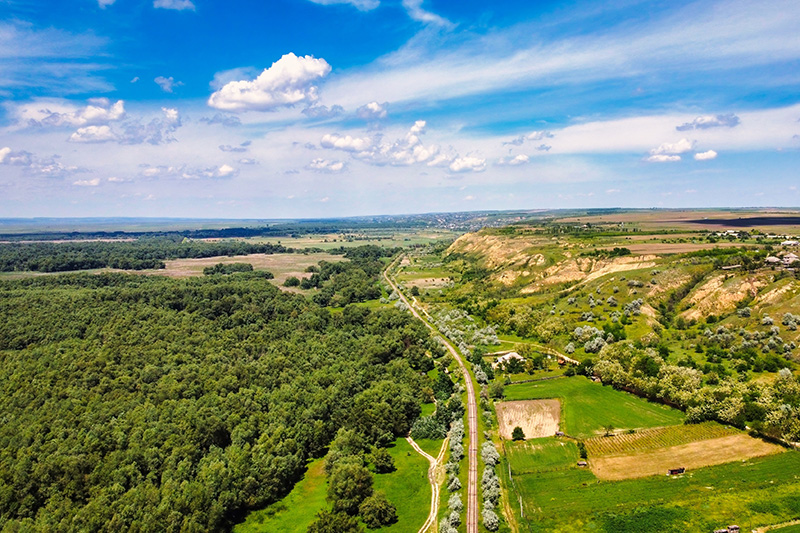
Moldova's forestry programme restored 20,300+ ha of degraded land and issued 851,911 carbon credits since 2003; a new 2023-2032 plan backed by the EU and World Bank targets 145,000 ha of afforestation/rehabilitation and 14,000 rural jobs to raise forest cover to 15%.
20,300+ hectares
Degraded land restored (2003-2012 predecessor project) (2003-2012)
Moldova Ministry of Environment / Agenția "Moldsilva" / World Bank / EU4Environment / GEF
Period
2003-2032
Keywords
forestry, climate finance, land restoration, rural development
Context
Moldova has one of Europe's lowest forest cover rates — historically under 10%, now around 12% — leaving degraded agricultural land vulnerable to erosion and limiting rural livelihoods. From 2003, a World Bank/BioCarbon Fund-supported Soil Conservation and Climate Change Project restored severely degraded land. Building on that record, Moldova adopted the National Forest Extension and Rehabilitation Programme (NFERP) on 17 February 2023, backed by the EU4Environment initiative and the World Bank.
Objectives
NFERP targets planting 110,000 hectares of new forest and rehabilitating 35,000 hectares of existing forest by 2032, raising national forest cover to at least 15%, creating nearly 14,000 rural jobs, and protecting habitat for 162 priority species under the pan-European Emerald Network.
Results
The completed 2003-2012 predecessor project restored more than 20,300 hectares of degraded land and generated 851,911 verified temporary Certified Emission Reductions (tCERs) — at the time the largest carbon-credit issuance from a reforestation project in the Emerging Europe and Central Asia region. NFERP itself, estimated at roughly €759 million, is projected to safeguard forest ecosystem services currently valued at about $70 million a year.
Conclusions
Independent verification of NFERP's own hectare and job-creation targets is not yet available since the programme runs through 2032; the strongest evidence to date rests on the completed 2003-2012 project, with the current phase resting on government and donor projections.
Implementation
Indicative cost
Very high (> €5M) — Estimated at roughly €759 million, supported by the EU4Environment initiative and the World Bank.
Time to results
Long (> 3 years) — Predecessor project ran 2003-2012; NFERP adopted February 2023 with targets set through 2032.
Staffing & skills
Moldova Ministry of Environment, Agenția "Moldsilva" (national forestry agency), World Bank, EU4Environment initiative, Global Environment Facility (GEF)
Conditions for success
Multi-decade government commitment, formalised by law adopted February 2023
Donor co-financing from the EU and World Bank
Institutional continuity from the completed 2003-2012 predecessor project
Common failure modes
Independent verification of hectare and job-creation targets for the new phase is not yet available since the programme runs through 2032
Where it fits
Governance type
national government programme with international donor co-financing
Scale
national
Income level
lower-middle-income
Data sources
Where this practice's information was retrieved from, and when.
Rwanda's FONERWA (est. 2012), Africa's first GCF-accredited national climate fund, has mobilised ~US$200M across 40+ projects, protecting ~20,000 ha from …
Suriname (~93% forest cover) runs a national jurisdictional REDD+ programme (NIMOS/SBB) that generated ~10M tCO2e in UNFCCC-validated results, 2018-2020. A …