evidoria

← Back to browse

Good practice Imported

Mongolia-ROK Friendship Park — Korea-Mongolia Urban Greenbelt Against Yellow Dust

Mongolia · Ulaanbaatar · See the Mongolia profile · See the Ulaanbaatar profile

Top 81% 33/100 · Ask Evidence Copilot about this practice

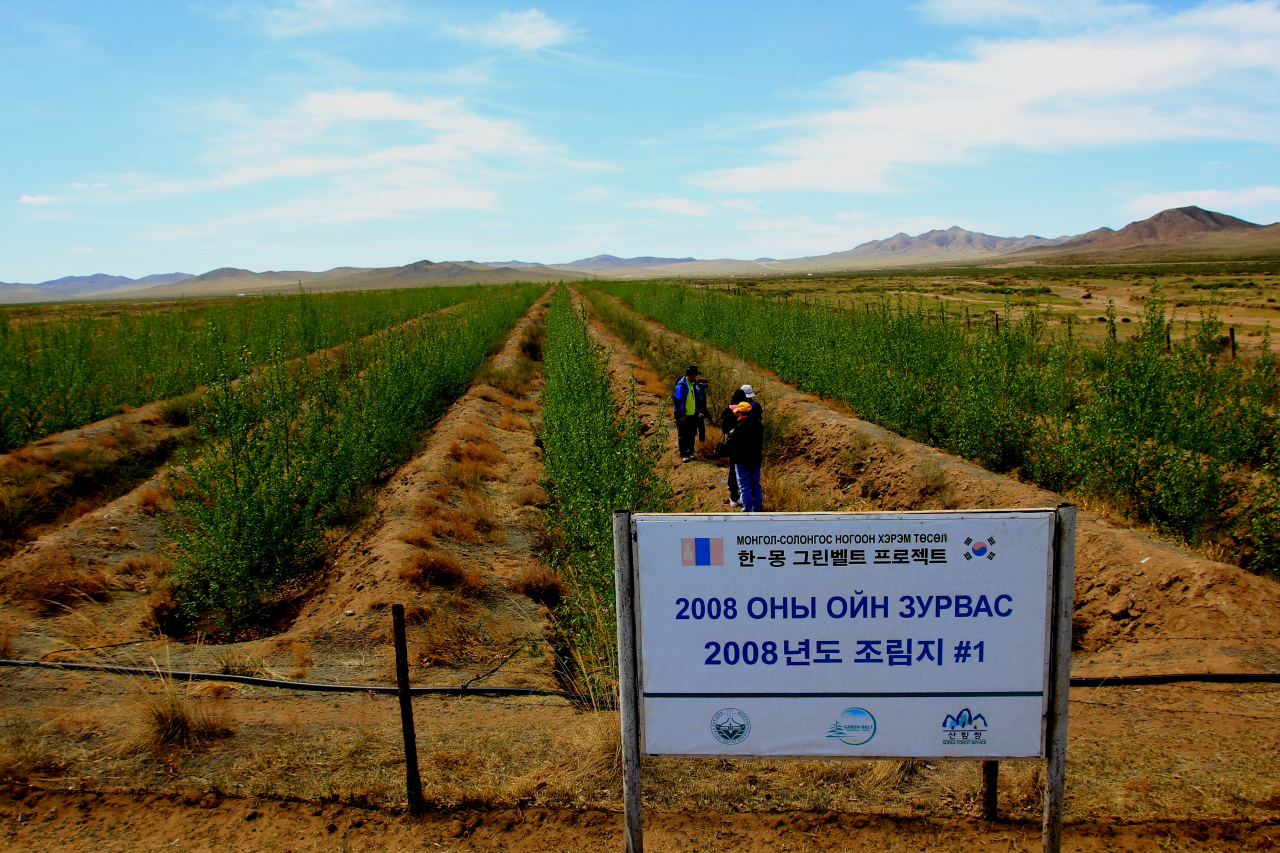
Korea's Forest Service and Mongolia's environment ministry built a 40-hectare urban forest in Ulaanbaatar's Sukhbaatar district (2017-2022), planting 55,000 trees and shrubs of 36 species to curb yellow-dust storms and air pollution in one of the world's most polluted capitals.

Mongolia-ROK Friendship Park — Korea-Mongolia Urban Greenbelt Against Yellow Dust

Details

Promoter
Korea Forest Service / Mongolia Ministry of Environment and Tourism
Period
2017-2022
Keywords
urban forestry, air pollution mitigation, desertification control, bilateral cooperation

Description

Ulaanbaatar suffers among the world's worst winter air pollution, driven largely by coal-stove heating in the city's ger districts, plus recurring yellow-dust storms linked to regional desertification. Before this project the city had almost no dedicated urban forest.

Under a forestry cooperation agreement the Korea Forest Service and Mongolia's Ministry of Environment and Tourism formalised in 2006, the two governments built the Mongolia-ROK Friendship Park, a 40-hectare urban forest in the 16th subdistrict of Ulaanbaatar's Sukhbaatar district, on land the ministry provided. Construction ran 2017-2022 in two phases: the first targeted yellow-dust suppression, the second aimed to cut urban air pollution. The two phases planted roughly 55,000 trees and shrubs across 36 species.

The project's scale — hectares planted, tree counts, species diversity, multi-year phased delivery under a bilateral government agreement — is documented in Mongolian and Korean media and independently catalogued in the Urban Nature Atlas nature-based-solutions database. No published air-quality or dust-reduction monitoring specific to the park was found, so the evidence here sits at the output level (area, trees, funding partners, land tenure) rather than a measured pollution or carbon outcome.

Read the full analysis: https://www.koreaherald.com/article/3415367

Implementation

Implementation detail (cost, timeline, staffing, conditions for success) is not yet available for this practice.

Do you run this practice? Claim it — verified implementers get a public contact pathway and can propose corrections.

Data sources

Where this practice's information was retrieved from, and when.

Attachments

Similar practices you may find useful