Thailand 'AI for Teachers' — Upskilling 160,000 Educators Nationwide
Thailand
Government programme that trained and certified 160,507 Thai educators in ethical AI use, saving 4 hrs/week per teacher, and reaching …
Morocco · Rabat · See the Morocco profile · See the Rabat profile
Evidence: Descriptive / self-reported Top 40% 53/100 · Ask Evidence Copilot about this practice
Morocco's DigiSchool (Feb 2024) trained 265 secondary teachers in AI, VR and coding across all 12 regions; teacher-led follow-up reached 2,650 students; 714 competed in 12 regional hackathons; the 2025 target is 1,800 teachers and 36,000 students nationwide.
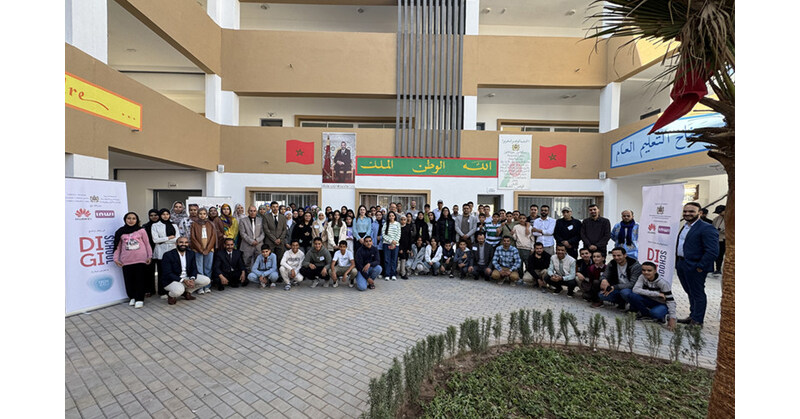
Launched in February 2024 as a public-private partnership between Morocco's Ministry of National Education, Preschool and Sports and Huawei Morocco under the global TECH4ALL digital-inclusion initiative, DigiSchool set out to equip secondary-school teachers and students with practical skills in artificial intelligence, virtual reality, web/app development and robotics.
Phase 1 (Feb–Apr 2024) trained secondary-school teachers in ICT and AI skills across all 12 regional academies of Morocco, with deliberate reach into rural areas. Phase 2 had trained teachers deliver follow-up sessions to students through a cascade 'ambassador' model. Phase 3 (May–Nov 2024) ran twelve regional hackathons where students designed and pitched ICT/AI solutions to local education challenges. Phase 4 (Dec 2024) ran technology bootcamps in Fez, Marrakech and Agadir, concluding with a ministerial evaluation.
By the end of 2024, the programme had trained 265 teachers, reached 2,650 students through 71 follow-up sessions, and engaged 714 students in regional hackathons, plus 180 students and 60 teachers in bootcamps. For 2025 the programme targets 48 DigiSchool clubs, 1,800 trained teachers and 36,000 students nationwide — a 6.8-fold scale-up. No standardised assessment of learning outcomes has been published; evidence rests on implementation-reach and participation metrics.
Philanthropic / foundation funding
Indicative funding routes for practices of this type — always check each programme's current calls and eligibility rules.
Do you run this practice? Claim it — verified implementers get a public contact pathway and can propose corrections.
Where this practice's information was retrieved from, and when.
Thailand
Government programme that trained and certified 160,507 Thai educators in ethical AI use, saving 4 hrs/week per teacher, and reaching …
Taiwan
Taiwan's MoE integrates AI into its free national Adaptive Learning Platform (TALP) for K-12. A quasi-experiment (n=4,442 sixth-graders) showed significant …
Kenya
Announced 19 May 2026 alongside Pakistan, Brazil and India, this Google.org-funded, UNICEF-implemented partnership works with Kenya's national Government on three …
Czechia
Czech Republic's EUR 3.95M National Recovery Plan-funded AIDIG project trains teachers at all school levels in AI integration using the …
Open full copilot Grounded in cited practices — always check the sources.