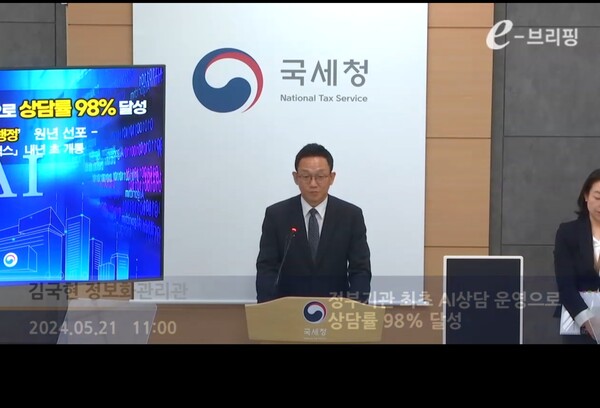
In May 2024, South Korea's National Tax Service became the first agency to run an AI voice consultant on its 126 tax hotline, lifting call-success from 24% to 98%, handling 1,250 concurrent calls and 2.7x more consultations at roughly 5% of the cost of 1,000 extra staff.
24% -> 98%
Call-success rate (2023-2024)
~840,000
Total consultations (2024)
2.7x
Consultation volume increase (2024)
1,250
Concurrent call capacity
KRW 400 million vs. KRW 8 billion (~5%)
System cost vs. equivalent staffing
Details
Maturity
Established
Promoter
National Tax Service (NTS), Republic of Korea
Period
2024
Keywords
Tax administration, citizen services, voice AI, contact centre
Context
South Korea's national tax hotline '126' connected only 24% of calls successfully during the previous year's peak filing period.
Activities
In May 2024, the National Tax Service became the first Korean agency to deploy an AI voice-recognition consultant, trained on more than two million past consultation records plus tax law and precedents, fielding up to 1,250 concurrent calls around the clock.
Results
Call-success rate rose from 24% to 98% in 2024, with total consultations climbing to roughly 840,000 — 2.7 times the prior year's volume — at an estimated system cost of about 5% of hiring the equivalent counsellor capacity.
Implementation
Indicative cost
Low (< €50k) — NTS estimated system cost at ~KRW 400 million versus a projected KRW 8 billion to hire ~1,000 additional counsellors.
Time to results
Short (< 1 year) — Deployed May 2024 during comprehensive income tax filing season.
Staffing & skills
National Tax Service call-centre staff (human specialists for complex cases)
Conditions for success
training on 2M+ past consultation records plus tax law/regulations
24/7 operation including holidays
Common failure modes
no public data on misdirection rates or complaint volumes
no independent audit of headline figures
Commonly funded by
National / regional programmes
Indicative funding routes for practices of this type — always check each programme's current calls and eligibility rules.
Do you run this practice?
Claim it —
verified implementers get a public contact pathway and can propose corrections.
Data sources
Where this practice's information was retrieved from, and when.
Rwanda's RISA-run IremboGov platform, now covering 223 government services, added a Kinyarwanda/English/French AI chatbot for citizen support; independent analysis found …