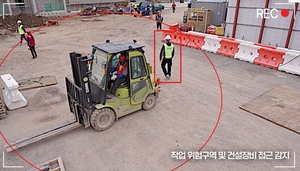
Korea Land & Housing Corporation's AI-and-IoT monitoring system flags missing hard hats, falls and danger-zone breaches on 311 construction sites; LH reports site accidents fell from 263 in 2024 to 160 in 2025, about 40% lower.
311
Construction sites deployed (as of March 2026)
-40% (263→160)
Safety accidents, year-on-year change (2024–2025)
Details
Maturity
Scaling
Promoter
Korea Land & Housing Corporation (LH)
Period
2022-2026
Keywords
construction, occupational safety, public housing, AI/IoT monitoring
Context
Korea Land & Housing Corporation (LH) has deployed 'Neulbom A-Eye', an AI+IoT system analysing CCTV and sensor data to detect safety hazards (missing helmets, falls, unauthorised entry) across 311 construction sites as of March 2026.
Results
LH reported safety accidents fell from 263 in 2024 to 160 in 2025 (about 40% year-on-year), though it did not publish an independent evaluation isolating the AI system's contribution from other safety measures introduced over the same period; an earlier 2021–22 Seoul Metropolitan Government pilot cut emergency-alert response times from 5–10 minutes to about 30 seconds.
Implementation
Indicative cost
Medium (€50k–€500k)
Time to results
Medium (1–3 years)
Staffing & skills
LH site managers, IoT-linked warning system operators
Conditions for success
Daily concentration on the 20 highest-risk sites rather than even resource spread
Commonly funded by
National / regional programmes
Indicative funding routes for practices of this type — always check each programme's current calls and eligibility rules.
Do you run this practice?
Claim it —
verified implementers get a public contact pathway and can propose corrections.
Data sources
Where this practice's information was retrieved from, and when.