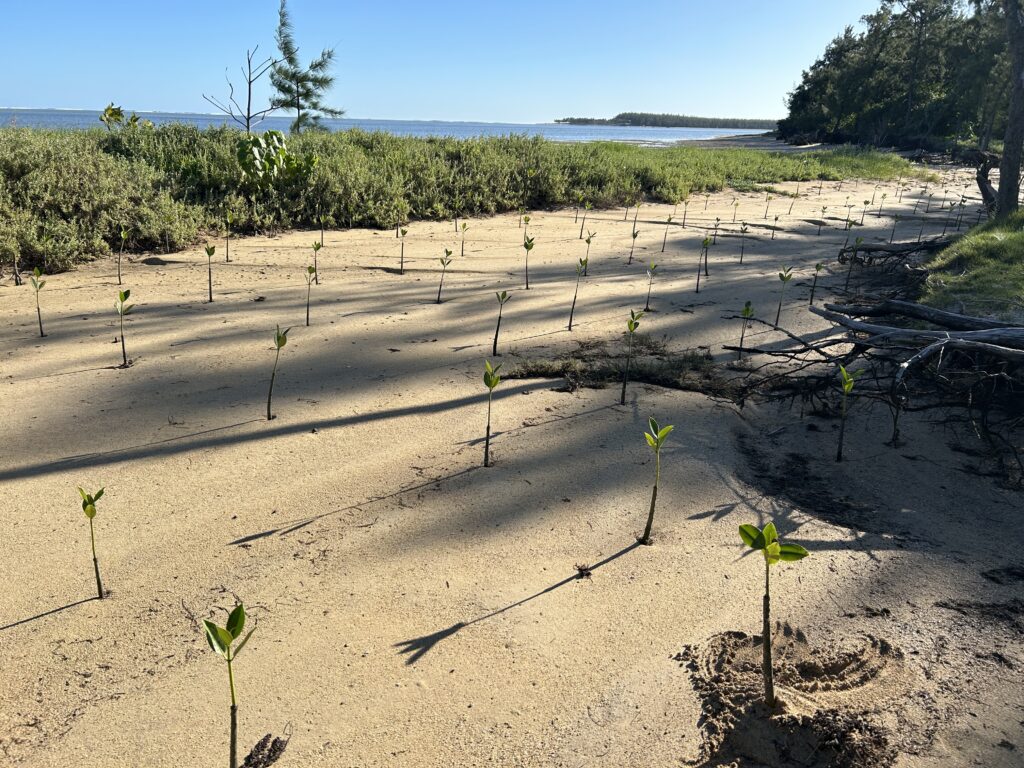
Le Morne and neighbouring Case Noyale, on Mauritius's south-west coast, lost mangrove cover to coastal development, leaving degraded shoreline with weaker storm buffering and fewer fish nurseries.
The Odysseo Foundation, launched in 2024 by Mauritius's Odysseo oceanarium together with ADD, Attitude Foundation, Solidarité and Varuna, has planted mangroves toward a 10,000-tree target between Le Morne and Case Noyale (Cotteau Raffin) and established what it describes as the Indian Ocean's first seed-based seagrass nursery, continuing restoration work on stands that in some cases predate the Foundation's own 2024 launch.
A June 2026 peer-reviewed study in Scientific Reports sampled organic-carbon stocks across an age-structured chronosequence of restored mangrove stands at Le Morne, finding organic matter and carbon stocks up to fourfold higher and nearly double in older versus younger stands, with net carbon gains of roughly 14.3 Mg C/ha (about 265.9 Mg CO2-eq/ha across the restoration programme). The same study measured Syringodium isoetifolium and Halodule uninervis seagrass meadows at Le Morne, Case Noyale and Coteau Raffin storing on average 10.8 Mg C/ha, comparable to or exceeding other Western Indian Ocean estimates.
Because the chronosequence includes stands planted well before the Foundation existed, the carbon results reflect a longer restoration history than Odysseo's own tenure, and independent, quantified biodiversity or erosion-control outcomes for the site are not yet published.
Read the full analysis: https://odysseomauritius.com/foundation/blue-carbon-ecosystem/
Where this practice's information was retrieved from, and when.