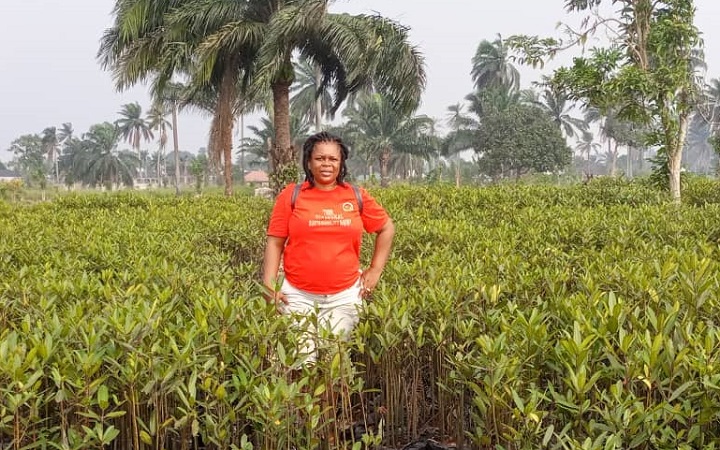
Since 2018, Lokiaka Community Development Centre has trained ~300 Ogoni women in four Niger Delta communities who planted 2.6 million mangroves in oil-damaged Bodo Creek, Yaataa and Teenama swamps, self-reporting 80-96% survival toward 5 million more by 2030.
~300
Women trained in nursery-raising and planting
2.6 million
Mangrove seedlings planted (2018–early 2025)
80–96 %
Self-reported seedling survival rate
5 million trees
Additional planting target (following five years (from 2025))
6,000+
Oil spills recorded in the region (past decade)
Details
Promoter
Lokiaka Community Development Centre
Period
2016–ongoing (planting since 2018)
Keywords
mangrove restoration, community forestry, gender empowerment, coastal resilience, oil-pollution remediation
Context
The Lokiaka Community Development Centre, founded by Ogoni activist Martha Agbani, runs a women-led mangrove restoration programme in Rivers State, Nigeria, responding to decades of oil pollution — including the 2003 Bodo Creek oil spill — that destroyed mangrove swamps around Bodo Creek and undermined the fishing and farming livelihoods local women depend on.
Objectives
The organisation aims to plant a further 5 million trees over the following five years, building on training begun in 2016 and active replanting from 2018.
Activities
The centre has trained roughly 300 women across four Ogoni communities (including Bodo Creek, Yaataa and Teenama) in nursery-raising and planting techniques. Participation is nominally voluntary; some women sell seedlings raised in their nurseries to contractors, and others have been hired as paid contract staff on other planting initiatives, in a region where more than 6,000 oil spills have been recorded over the past decade.
Results
As of early 2025, the women had collectively planted 2.6 million mangrove seedlings, which Lokiaka estimates survive at a rate of 80–96% depending on the site. Two independent journalism outlets — Mongabay and Nigeria's The Cable — have corroborated the programme's core figures and community-training model through site reporting.
Conclusions
The survival-rate and planting-volume figures are self-reported by Lokiaka rather than independently audited, and no third-party monitoring body or certification scheme is cited; neither corroborating outlet reports independent ecological measurement of carbon sequestration, biodiversity recovery or shoreline stabilisation.
Implementation
Indicative cost
Low (< €50k) — Not quantified in sources reviewed.
Time to results
Medium (1–3 years) — Training began 2016; active replanting from 2018; as of early 2025, 2.6 million seedlings planted, with a target of 5 million more over the following five years.
Staffing & skills
Lokiaka Community Development Centre, led by founder Martha Agbani, ~300 trained community women across four Ogoni communities
Conditions for success
Community-based training in nursery-raising and planting techniques
Income incentives (seedling sales to contractors, paid contract planting work) that sustain participation
Common failure modes
Survival-rate and volume figures are self-reported with no independent audit or third-party certification scheme
No independent ecological measurement (carbon sequestration, biodiversity recovery, shoreline stabilisation) has been published
Where it fits
Governance type
community-led NGO
Scale
four communities in Rivers State, Niger Delta
Do you run this practice?
Claim it —
verified implementers get a public contact pathway and can propose corrections.
Data sources
Where this practice's information was retrieved from, and when.