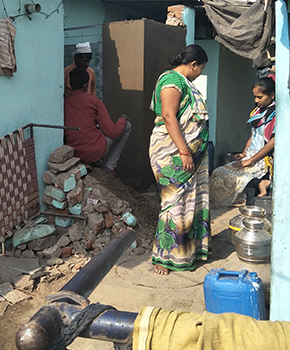
Launched in 1995, Ahmedabad's Parivartan programme used a four-way cost-share between the city, NGOs, private donors and residents to connect 41 slum communities (8,703 households, ~43,500 people) to water and sewerage by 2005, alongside a documented mortality decline.
8,703
Households connected to water & sewerage (1995-2005)
~43,515
Residents reached (1995-2005)
41
Slum communities connected (by December 2005)
6.9 to 3.7 per 1,000
Crude death rate decline
Rs 2,000
Household contribution per connection
Details
Maturity
Established
Promoter
Ahmedabad Municipal Corporation, Mahila Housing Trust & SEWA
Period
1995–2006 (city-wide roll-out); municipal service integration ongoing
Keywords
slum upgrading, water & sanitation, public health, municipal finance
Context
In 1995 the Ahmedabad Municipal Corporation (AMC) launched the Slum Networking Project, later branded Parivartan ('transformation'), beginning with a single pilot settlement, Sanjaynagar, before extending city-wide over the following decade. The programme rested on a four-partner cost-sharing structure: AMC supplied trunk infrastructure and technical support, private-sector and philanthropic donors (including the Arvind Mills/Lalbhai Group-backed initiative) co-funded works, the NGO network led by the Mahila Housing Trust (an offshoot of the Self-Employed Women's Association) organised women-led community groups to plan and manage connections, and participating households each contributed roughly Rs 2,000 toward their individual water, sewerage and drainage connection in exchange for legal recognition of tenure for the duration of the agreement.
Objectives
The programme aimed to extend basic infrastructure — piped water, underground sewerage, storm drainage, paved roads, streetlighting and solid-waste collection — into informal settlements without relocating residents, by combining municipal, private, NGO and household resources and by making service connection conditional on a modest household contribution and recognised tenure.
Activities
Implementation combined AMC-provided trunk infrastructure with community-level organising: the Mahila Housing Trust and SEWA network mobilised women-led community groups within each settlement to plan layouts and manage individual household connections, while private and philanthropic donors co-financed the works alongside AMC and participating households.
Results
By December 2005 the programme had reached 41 slum communities, connecting 8,703 households and roughly 43,515 residents to piped water, sewerage, drainage, paved roads, streetlighting and solid-waste collection. A household health survey associated the intervention with a fall in the crude death rate from 6.9 to 3.7 per 1,000, and in 2005 AMC received the Dubai International Award for Best Practice to Improve the Living Environment in recognition of the programme.
Conclusions
The World Bank and UN-Habitat cited Parivartan as good practice, and its four-partner financing model was referenced in slum-upgrading design in other Indian cities including Indore and Vadodara. However, expansion slowed markedly after the mid-2000s as municipal priorities shifted toward larger relocation-based housing schemes, and later assessments note that the programme reached only a fraction of Ahmedabad's total slum population before momentum faded.
Implementation
Indicative cost
Medium (€50k–€500k)
Time to results
Long (> 3 years)
Staffing & skills
municipal engineers (Ahmedabad Municipal Corporation), women-led community organisers (Mahila Housing Trust / SEWA), private-sector and philanthropic donor liaison (Arvind Mills/Lalbhai Group)
Conditions for success
a four-way cost-sharing structure combining municipal, private/philanthropic, NGO and household contributions
women-led community organising to plan and manage household-level connections
granting households legal tenure recognition in exchange for their financial contribution
Commonly funded by
National / regional programmesPhilanthropic / foundation funding
Indicative funding routes for practices of this type — always check each programme's current calls and eligibility rules.
Do you run this practice?
Claim it —
verified implementers get a public contact pathway and can propose corrections.
Data sources
Where this practice's information was retrieved from, and when.