Denver Water — From Forests to Faucets Watershed Protection Partnership (USA)
United States of America
After 1996 and 2002 wildfires choked Denver's reservoirs with sediment, Denver Water and the US Forest Service treated 120,000+ acres …
Netherlands · The Hague · See the Netherlands profile · See the The Hague profile
Evidence: Observational / pre–post Top 40% 47/100 · Ask Evidence Copilot about this practice
Between 2006 and 2019, Dutch authorities completed 34 flood-conveyance projects (€2.3bn) along the IJssel, Waal, Nederrijn and Lek — lowering dikes, widening floodplains and depoldering land, including the 4,450 ha Noordwaard polder — protecting roughly 4 million people.
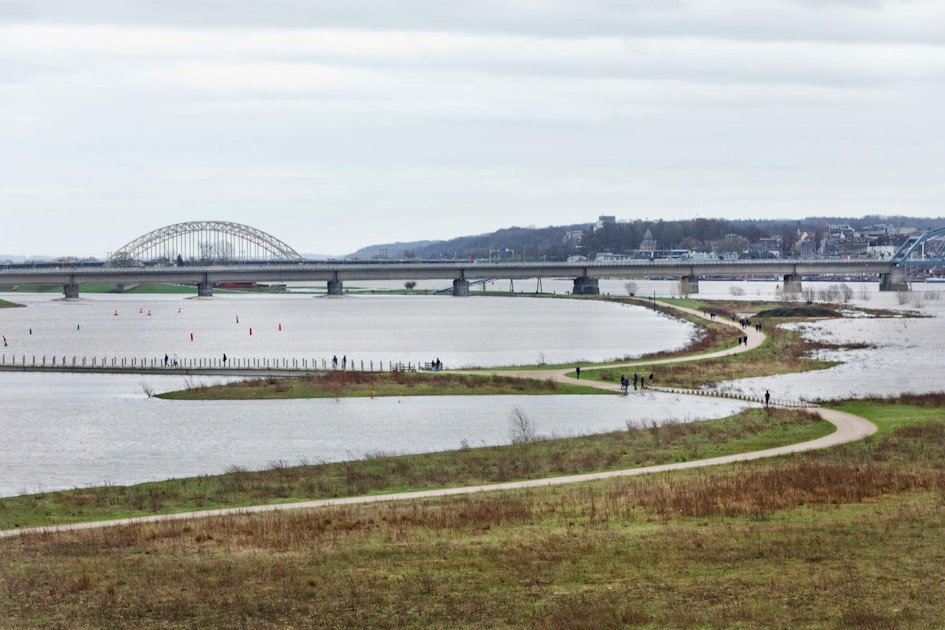
After near-catastrophic Rhine and Meuse floods forced mass evacuations in the Netherlands in the early-to-mid 1990s, Dutch authorities shifted flood-safety strategy away from ever-higher dikes toward giving rivers more physical room. The Room for the River programme was formally adopted in 2006, covering the Rhine's Dutch branches — the IJssel, Waal, Nederrijn and Lek.
Increase river discharge capacity and lower flood risk by widening floodplains and relocating dikes, rather than raising them further.
Between 2006 and 2019, national and regional authorities completed 34 measures for a combined EUR 2.3 billion: relocating dikes further from the riverbank, lowering floodplains, reducing groyne heights, deepening side channels, and depoldering land. The largest single measure, the Noordwaard polder near the Biesbosch, cost about EUR 300 million and converted roughly half of its 4,450 hectares into a controlled flood area, while ring levees protect the remaining 700 hectares of farmland; the number of farmers working the polder fell from 25 to 8 and households from 60 to 22, with relocation and compensation funded by the state.
Rijkswaterstaat reports that additional discharge capacity created near Gorinchem — where a 2 km stretch of levee was lowered by about 3 metres — is expected to lower Rhine water levels there by roughly 30 cm during high-flow events, part of a design target of safely conveying 16,000 m3/s. The programme is credited by Rijkswaterstaat and the OECD with improving flood safety for roughly 4 million people along these rivers.
Systematic, site-by-site before/after monitoring across all 34 projects is not published — the most specific quantified results (Noordwaard, Gorinchem) are single-site figures, and the discharge-capacity target is partly a modelled design standard rather than an observed flood outcome.
National / regional programmes
Indicative funding routes for practices of this type — always check each programme's current calls and eligibility rules.
Do you run this practice? Claim it — verified implementers get a public contact pathway and can propose corrections.
Where this practice's information was retrieved from, and when.
United States of America
After 1996 and 2002 wildfires choked Denver's reservoirs with sediment, Denver Water and the US Forest Service treated 120,000+ acres …
United States of America
Seattle's ~100,000-acre Cedar River Municipal Watershed programme won EPA's rare 'Limited Alternative to Filtration' status in 2004, saving over $100 …
Australia
Melbourne has kept the public and farming out of its mountain-ash forest catchments since 1879, so over 65% of its …
United States of America
Rather than build an $8–10bn filtration plant, New York City invests in protecting its Catskill/Delaware watershed — ~$2.5bn since 1997 …
Open full copilot Grounded in cited practices — always check the sources.