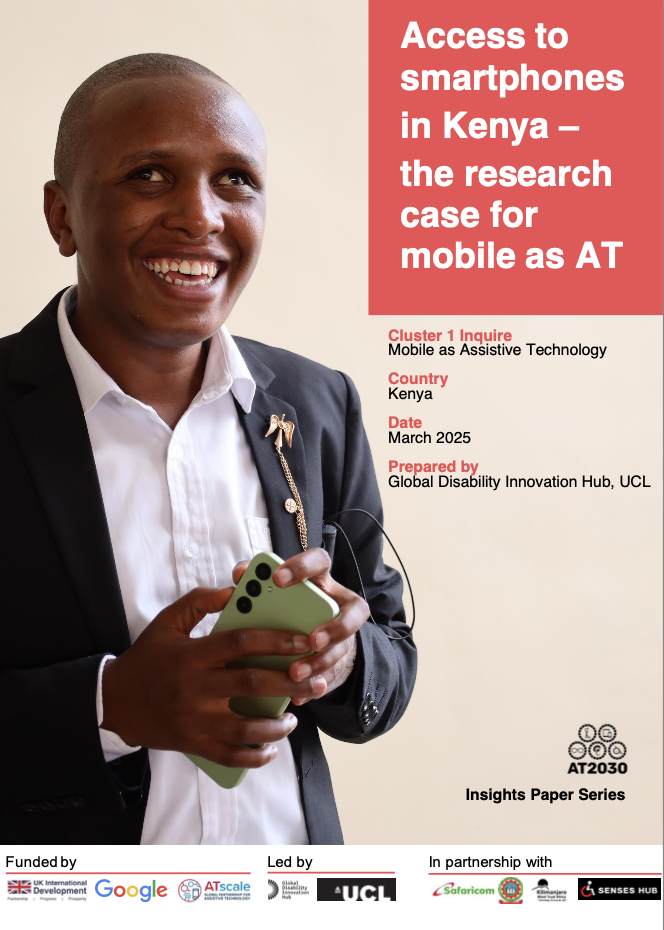
A six-month AT2030 study by the Global Disability Innovation Hub gave 193 Deaf/hard-of-hearing and blind/partially-sighted Kenyans smartphones and accessibility-feature training, delivered locally in Kisumu by Kilimanjaro Blind Trust Africa.
78.8 %
Blind/partially-sighted participants with measurable improvement in digital proficiency
71.8 %
Deaf/hard-of-hearing participants with measurable improvement in digital proficiency
193
Total study participants
90 %
People with disabilities in LMICs lacking access to assistive technology (estimate)
6 months
Study duration
Details
Maturity
Pilot
Promoter
Global Disability Innovation Hub (UCL, AT2030 Programme) with Kilimanjaro Blind Trust Africa
Period
2023-2025
Keywords
assistive technology, digital inclusion, disability, smartphone accessibility
Context
The Global Disability Innovation Hub (GDI Hub), through the UK-aid-funded AT2030 programme, partnered with Google and ATscale to test smartphones as assistive technology in Kenya, where an estimated 90% of people with disabilities in low- and middle-income countries lack access to assistive technology.
Objectives
The study set out to test whether an ordinary smartphone, paired with training on its built-in accessibility features, could function as effective assistive technology for Deaf/hard-of-hearing and blind/partially-sighted adults.
Activities
A mixed-methods longitudinal study ran for six months with 193 participants split between Deaf/hard-of-hearing (DHH) and blind/partially-sighted (BPS) adults. Each received a smartphone and training tailored to built-in Android accessibility features -- TalkBack for BPS users, Live Transcribe and Live Caption for DHH users -- following a baseline survey, training, and a follow-up survey and interviews. Local delivery in Kisumu County (West Seme Ward) was carried out by Kilimanjaro Blind Trust Africa, reaching semi-urban and rural disability self-help groups such as the Semi Forum for Women with Disabilities.
Results
78.8% of BPS participants and 71.8% of DHH participants showed measurable improvement in digital proficiency, with participants reporting gains in independence, privacy, communication and access to information. Kisumu case-study participants described concrete follow-on benefits such as successfully writing funding proposals after training.
Conclusions
The figures come from GDI Hub's own insight papers rather than an independently audited evaluation, and long-term outcomes beyond the six-month study window are not yet published.
Implementation
Indicative cost
Medium (€50k–€500k) — No budget figures disclosed; costs include smartphone devices for 193 participants plus locally delivered accessibility training.
Time to results
Short (< 1 year) — Baseline survey, training and follow-up survey/interviews were completed within a six-month study window.
Staffing & skills
Global Disability Innovation Hub (GDI Hub, UCL) research team running the AT2030 programme, Local delivery partner Kilimanjaro Blind Trust Africa in Kisumu County, Disability self-help groups such as the Semi Forum for Women with Disabilities as community access points
Conditions for success
Training tailored to the specific built-in accessibility feature relevant to each group (TalkBack for BPS; Live Transcribe/Live Caption for DHH)
Local delivery through an established disability-focused implementing partner
Reaching participants through existing semi-urban and rural disability self-help groups
Common failure modes
Findings rely on GDI Hub's own insight papers rather than an independently audited evaluation
No published outcome data beyond the six-month study window
Where it fits
Governance type
international research hub (UCL) with UK-aid funding and a local NGO delivery partner
Scale
sub-national pilot (Kisumu County / West Seme Ward)
Income level
low-income
Commonly funded by
Philanthropic / foundation funding
Indicative funding routes for practices of this type — always check each programme's current calls and eligibility rules.
Do you run this practice?
Claim it —
verified implementers get a public contact pathway and can propose corrections.
Data sources
Where this practice's information was retrieved from, and when.