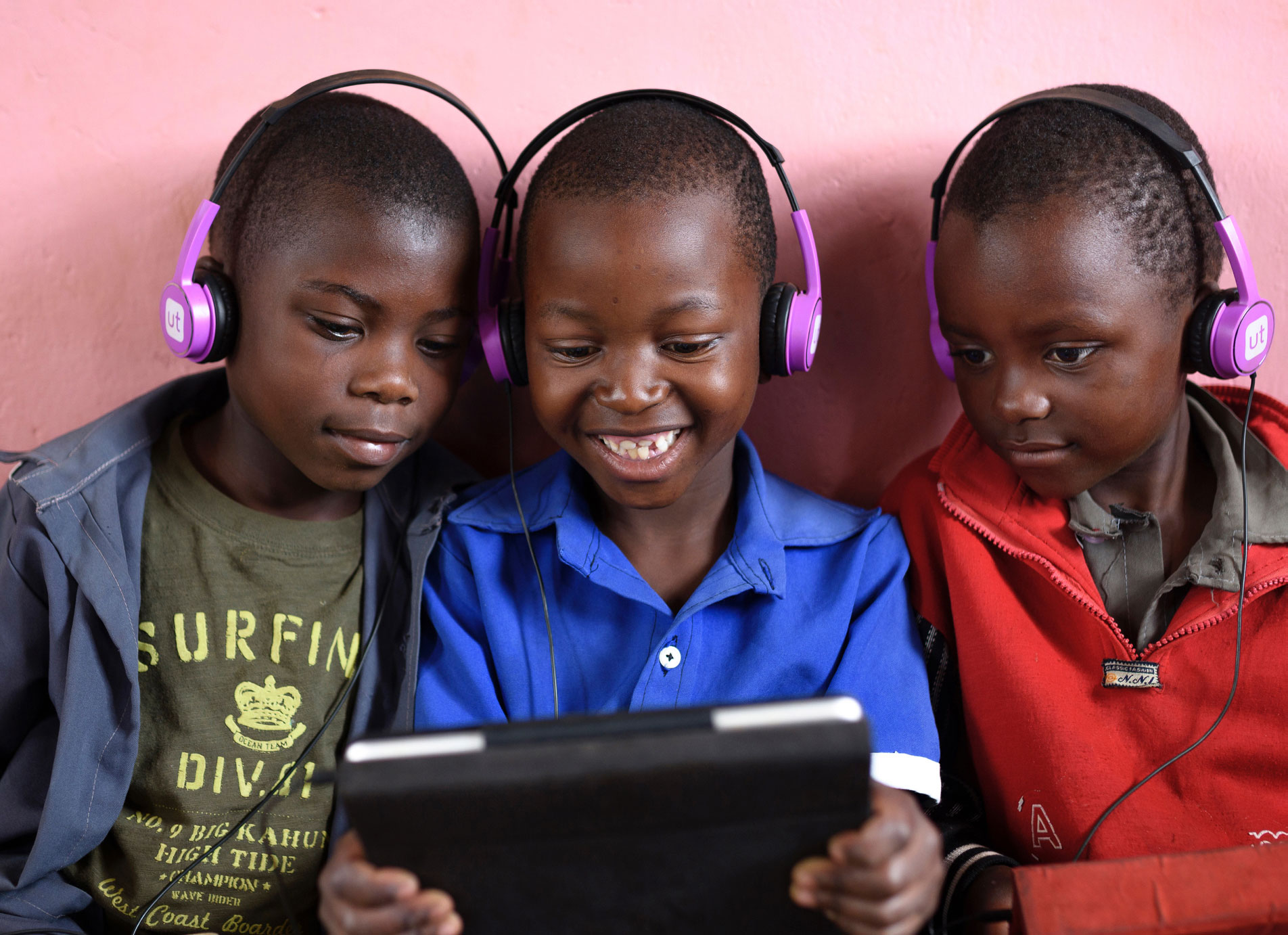
Imagine Worldwide, maker of the RCT-validated onebillion app, piloted tablet literacy/numeracy teaching with CRS in two Burkina Faso schools, scaled to 16 schools and 7,500+ pupils via USDA's McGovern-Dole programme, then shut down in May 2025 when funding ended.
2 schools
Schools in pre-pilot (2021)
16 government primary schools
Schools after 2023 expansion (2023)
7,500+ students
Planned students to be served over 3 years (2023-2025 (planned))
Details
Maturity
Discontinued
Promoter
Imagine Worldwide / Catholic Relief Services
Period
2021–2025 (discontinued)
Keywords
Primary education, adaptive-learning tablets, rural and food-insecure communities
Context
Imagine Worldwide — the NGO behind the onebillion adaptive-learning app, whose tablet-based reading and maths instruction has multiple randomised controlled trials showing gains for both girls and boys in Malawi — began work in Burkina Faso with a two-school pre-pilot in Pissila and Tibtenga (Sanmatenga province), delivering tablet-based instruction to grades 1–3 to test whether its delivery model and software translated to a new context.
Activities
Following that pre-pilot, the programme expanded in 2023 to 16 government primary schools, in partnership with Catholic Relief Services and funded through the USDA McGovern-Dole International Food for Education and Child Nutrition Program, with a three-year plan to serve more than 7,500 students.
Results
No Burkina-Faso-specific learning-outcome results have been published.
Conclusions
The programme was discontinued in May 2025 when its McGovern-Dole funding ended. Imagine Worldwide's own account of its current country portfolio (as of September 2025) lists only Malawi, Sierra Leone and Tanzania — Burkina Faso is no longer part of its active work. The case illustrates a common risk for donor-funded EdTech pilots in fragile contexts: strong delivery-model validation elsewhere does not guarantee continuity once a single funding stream ends, and reach figures should not be read as evidence of sustained impact.
Implementation
Indicative cost
Medium (€50k–€500k) — Funded through the USDA McGovern-Dole International Food for Education and Child Nutrition Program; tablet-based hardware deployment across 16 schools; specific budget figures not disclosed in sources.
Time to results
Medium (1–3 years) — Pre-pilot from 2021 in 2 schools; expanded 2023 to 16 schools with a 3-year plan; discontinued May 2025 when McGovern-Dole funding ended.
Staffing & skills
Delivered in partnership with Catholic Relief Services, Uses onebillion's tablet-based instructional software; grades 1-3 target
Conditions for success
Prior successful RCT validation of the underlying software/delivery model in Malawi
Sustained donor funding stream (this case shows what happens when it is not sustained)
Common failure modes
Single-donor dependency: the programme ended entirely when USDA McGovern-Dole funding concluded in May 2025
No independent outcome evaluation was conducted or published specific to the Burkina Faso deployment before discontinuation
Where it fits
Governance type
NGO/donor-funded programme in partnership with government primary schools
Scale
16 schools, targeting 7,500+ students (discontinued before full scale reached)
Income level
low-income, rural, food-insecure region (Sanmatenga province)
Commonly funded by
Philanthropic / foundation funding
Indicative funding routes for practices of this type — always check each programme's current calls and eligibility rules.
Do you run this practice?
Claim it —
verified implementers get a public contact pathway and can propose corrections.
Data sources
Where this practice's information was retrieved from, and when.
Jamaica's 2022 pilot developed accessible digital storybooks tested in five schools—four for deaf, blind and intellectually disabled students. UNICEF's 10-country …
Djibouti's education ministry piloted Lexplore, an AI eye-tracking tool that screens children's reading level and developmental delays like dyslexia in …
A peer-reviewed Fiji Ministry of Education study combined child-functioning survey data with learning-support-needs data in a rule-based algorithm that more …