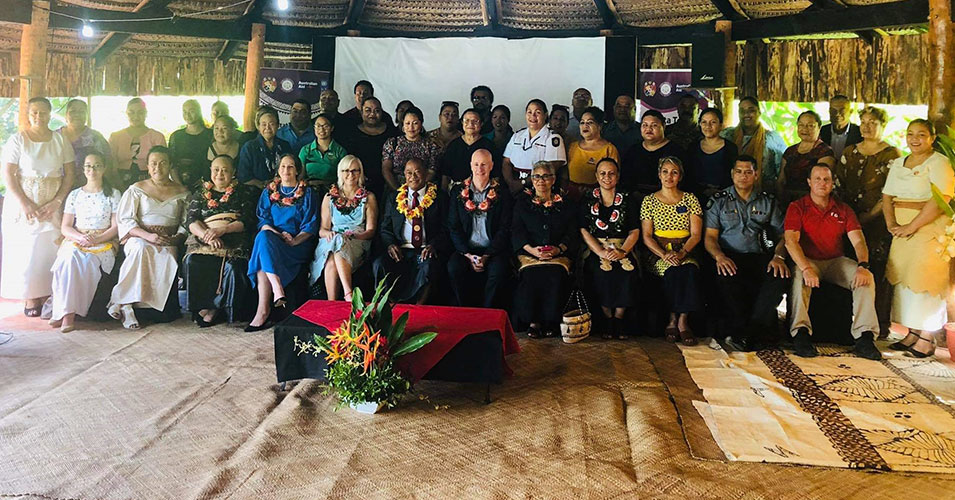
Tonga's Family Protection Legal Aid Centre, opened 2018 as the Pacific's first dedicated GBV legal-aid service, served 139 clients (incl. 53 protection-order cases) in 3 months. A 2021 UNDP-backed portal added anonymous online access.
justice sector, legal aid, gender-based violence, digital government services
Context
More than one in three Tongan women (39.6%) have experienced intimate partner violence, and until 2018 no dedicated, free legal-aid service existed for survivors.
Objectives
To provide free legal advice and representation to survivors of domestic and family violence, and later to extend anonymous, remote access to legal information and safety planning.
Activities
Tonga's Ministry of Justice opened the Family Protection Legal Aid Centre (FPLAC) on 12 March 2018, the first service of its kind in the Pacific. On 21 July 2021, with UNDP support, the centre launched an online portal and mobile app (fplac.justice.gov.to) allowing survivors to access legal information, build safety plans and report family violence anonymously and remotely.
Results
In its first three months of operation (March-June 2018), FPLAC served 139 clients, including 53 women assisted with protection-order applications.
Conclusions
Available public reporting covers service uptake rather than outcome evaluation; there is no published assessment of case-resolution rates or survivors' longer-term safety, and domestic violence in Tonga remains under-reported because of stigma, economic dependence and family pressure.
Implementation
Indicative cost
Medium (€50k–€500k)
Time to results
Medium (1–3 years)
Staffing & skills
Ministry of Justice, Government of Tonga, UNDP (funding and technical support for the 2021 digital portal)
Conditions for success
A free service, removing cost as a barrier to legal representation
Anonymous, remote digital access to reduce stigma and safety risks of in-person reporting
Common failure modes
No published assessment of case-resolution rates or survivors' longer-term safety
Domestic violence remains under-reported in Tonga because of stigma, economic dependence and family pressure
Commonly funded by
National / regional programmes
Indicative funding routes for practices of this type — always check each programme's current calls and eligibility rules.
Do you run this practice?
Claim it —
verified implementers get a public contact pathway and can propose corrections.
Data sources
Where this practice's information was retrieved from, and when.
Founded in 2010, Armenia's Women's Support Center is the country's only organisation running full-time shelters for domestic-violence survivors, growing from …