Sinapses — Brazil's Mandatory National Registry and Risk-Audit Platform for Judicial AI
Brazil
Brazil's National Council of Justice runs Sinapses, a national catalogue where all AI models used or developed by the Brazilian …
Tuvalu · Funafuti · See the Tuvalu profile · See the Funafuti profile
Evidence: Observational / pre–post Top 22% 73/100 · Ask Evidence Copilot about this practice
Tuvalu's Fisheries Department has run nearly 60 satellite scans since a December 2021 pilot, using radar imagery and machine-assisted vessel matching to spot 'dark' boats not broadcasting their position across up to 80% of its 750,000 km² exclusive economic zone.
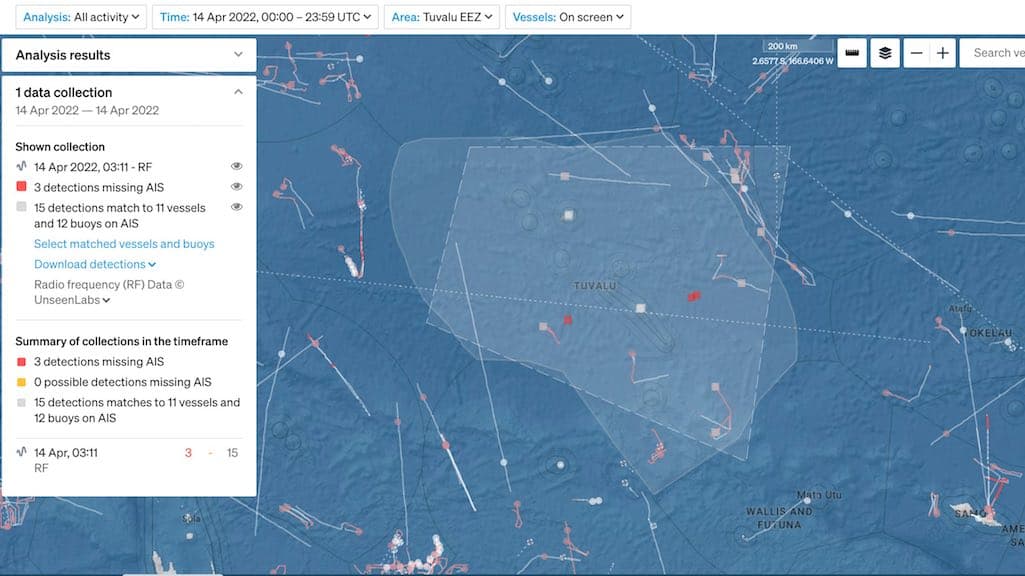
Since a December 2021 pilot, Tuvalu's Fisheries Department has used satellite-based surveillance to search its 750,000 km² exclusive economic zone for vessels fishing without broadcasting their position, funded by the World Bank's Pacific Islands Regional Oceanscape Program (PROP).
Synthetic-aperture radar and navigational-radar imagery are matched automatically against known vessel positions on the Starboard Maritime Intelligence platform, originally developed by New Zealand's Xerra Earth Observation Institute, to flag likely 'dark' vessels; the same programme and platform are used by Micronesia, Kiribati, the Marshall Islands, Solomon Islands and Tonga.
Nearly 60 satellite scans have been carried out since December 2021, each covering up to 80% of the EEZ; most scans have turned up at least one potentially dark vessel.
Tuvalu has not published conviction, fine or revenue-recovery figures tied to the programme, and Starboard's proprietary vessel-classification model cannot be independently verified for detection accuracy — a point of note given fisheries access fees make up more than 55% of Tuvalu's government revenue.
Do you run this practice? Claim it — verified implementers get a public contact pathway and can propose corrections.
Where this practice's information was retrieved from, and when.
Brazil
Brazil's National Council of Justice runs Sinapses, a national catalogue where all AI models used or developed by the Brazilian …
United Kingdom
The UK's Algorithmic Transparency Recording Standard grew from a 2022 pilot into a mandatory register covering all central government departments, …
Australia
Australia's Digital Transformation Agency piloted a draft AI impact-assessment framework with 21 volunteer federal agencies, testing whether it caught risks …
Canada
Since April 2019, Canada's Directive on Automated Decision-Making has required every federal automated decision system to complete a public Algorithmic …
Open full copilot Grounded in cited practices — always check the sources.