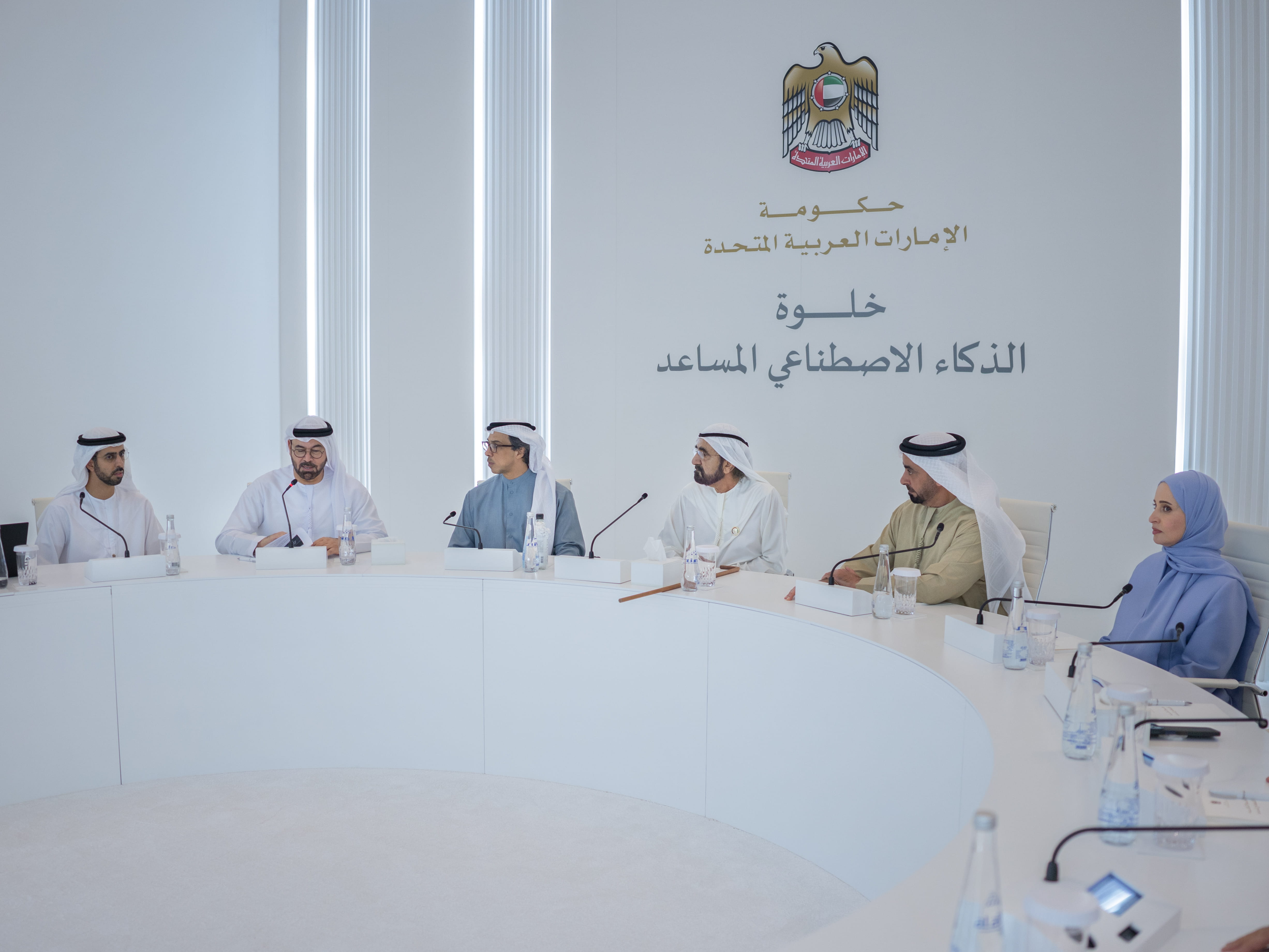
At a May 2026 national retreat, the UAE federal government launched its first four 'agentic AI' systems — for procurement, tax auditing, customer service and IT support — the opening move of a plan to convert 50% of services to AI-run operations within two years.
400+ officials
Ministers and federal officials attending the launch retreat (20 May 2026)
50 %
Target share of federal services converted to agentic AI (within 2 years)
80000 employees (approx.)
Government employees to be trained across five skill tracks
64 %
UAE IT leaders doubting data infrastructure readiness for agentic AI
48 %
Global average of IT leaders doubting data infrastructure readiness
Details
Maturity
Pilot
Promoter
UAE Prime Minister's Office and Ministry of AI, Digital Economy and Remote Work Applications
Period
2026
Keywords
public administration, procurement, tax administration, customer service, IT operations, agentic AI
Context
On 20 May 2026, UAE Vice President and Prime Minister Sheikh Mohammed bin Rashid Al Maktoum led a national retreat in Abu Dhabi, attended by more than 400 ministers and federal officials, to unveil the next phase of the UAE Government's Agentic AI programme, framed by Minister Omar Sultan Al Olama as moving government AI beyond task automation toward 'independent thinking, planning, and execution.'
Objectives
The retreat introduced the government's first operational batch of specialised agentic AI systems — a Procurement Agent, a Tax Auditing Agent, a Customer Happiness Agent, and a Technical Support Agent — with an explicit goal to convert 50% of federal government services and operations to agentic AI within two years, backed by training for roughly 80,000 government employees across five skill tracks.
Activities
The Procurement Agent streamlines government sourcing and purchasing workflows; the Tax Auditing Agent strengthens data verification and compliance review; the Customer Happiness Agent gives service staff faster access to information for citizen-facing interactions; and the Technical Support Agent triages and resolves internal IT issues.
Results
As of this review, no UAE government source had published operational results for the four agents — no processing volumes, time savings, cost figures, or error rates — since the programme was announced only weeks earlier.
Conclusions
Independent analysis of the UAE's wider agentic-AI push flags a real readiness gap behind the ambition: regional surveys cited by industry analysts found 64% of UAE IT leaders doubt their data infrastructure can support agentic AI (versus 48% globally), only a minority of organisations report mature governance for autonomous agents, and roughly three times as many organisations are 'experimenting' with AI agents as are actually running them at scale. Because untraceable autonomous decisions create supervisory risk, the analysis argues governance needs to be built into the systems themselves — a test this specific programme has not yet had the chance to pass or fail in public.
Implementation
Indicative cost
Very high (> €5M) — National federal-wide programme training ~80,000 employees and targeting conversion of half of federal services within two years — no dollar figure disclosed but scale implies a very high budget.
Time to results
Medium (1–3 years) — Launched May 2026 with an explicit two-year target for 50% service conversion — a multi-year federal transformation programme.
Staffing & skills
UAE Prime Minister's Office, Ministry of AI, Digital Economy and Remote Work Applications (Omar Sultan Al Olama)
Conditions for success
Government-wide institutional backing at the Prime Minister/Vice President level
Training for roughly 80,000 employees across five skill tracks
Governance built into the agent systems themselves, rather than left to policy documents, given the supervisory risk of untraceable autonomous decisions
Common failure modes
Regional surveys find 64% of UAE IT leaders doubt their data infrastructure can support agentic AI, versus 48% globally
Only a minority of organisations report mature governance for autonomous agents
Roughly three times as many organisations are experimenting with AI agents as are running them at scale
No operational results (volumes, time savings, costs, error rates) have yet been published for the four agents
Commonly funded by
National / regional programmes
Indicative funding routes for practices of this type — always check each programme's current calls and eligibility rules.
Do you run this practice?
Claim it —
verified implementers get a public contact pathway and can propose corrections.
Data sources
Where this practice's information was retrieved from, and when.
Baden-Württemberg built F13, the first AI assistant in productive use across a full German state administration, running on sovereign infrastructure; …