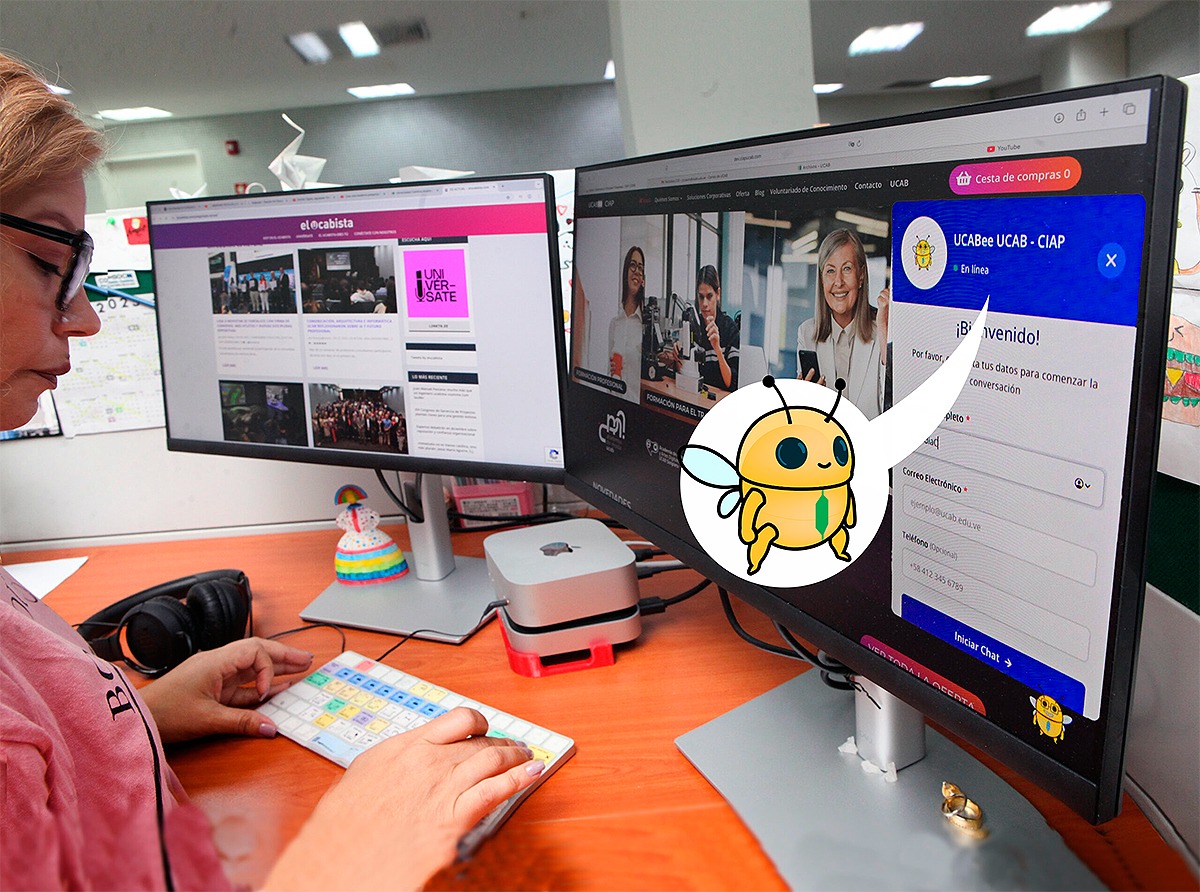
Venezuela's Universidad Católica Andrés Bello launched UCABee, a generative-AI chatbot for enrolment, tuition and scheduling queries, on 26 Feb 2026. It replaces a channel handling ~6,175 monthly requests; staff target 90% automated resolution.
~6,175 requests/month
Information requests fielded (October 2025, before launch) (October 2025)
~5,000 requests/month
Requests from CIAP alone (October 2025)
1,000–1,300 requests/week
CIAP request pace (October 2025)
up to 90 %
Target resolution rate for UCABee (target, 2026)
Details
Maturity
Pilot
Promoter
Universidad Católica Andrés Bello (UCAB) / En3D Venezuela
Period
Launched February 2026 – ongoing
Keywords
higher education administration, generative AI chatbot, student services, enrolment
Context
On 26 February 2026, Universidad Católica Andrés Bello (UCAB) in Caracas launched UCABee, a transactional chatbot powered by generative AI, initially on the website of its professional-development centre (CIAP) ahead of planned expansion to the university's main site and other schools and administrative units. UCABee is built as a central orchestration layer with secure API connections into UCAB's internal systems, letting it answer questions about study programmes, tuition costs, enrolment procedures, class schedules and room assignments with personalised, contextual responses.
Activities
UCABee is one part of a wider set of five AI tools UCAB rolled out with the Venezuelan firm En3D Venezuela in October–November 2025 (including a psychology-training chatbot and industrial-engineering VR simulators), indicating an institution-wide, resourced push into applied AI rather than an isolated experiment.
Results
The university reports that in October 2025 alone, before UCABee's launch, non-in-person channels — chiefly CIAP staff — fielded approximately 6,175 information requests, with roughly 5,000 of these from CIAP alone at a pace of 1,000–1,300 per week. UCAB's Director of Client Services, Edgar Pelayo, stated the goal is for UCABee to resolve up to 90% of requests and enquiries, reserving human staff for complex cases.
Conclusions
As of its first months of operation, UCAB has not published measured resolution rates, user-satisfaction data or comparisons against the pre-launch baseline, so the 90% target is a stated goal rather than a demonstrated result. The deployment is also confined to one university and one initial service channel, with wider rollout still pending.
Implementation
Indicative cost
Medium (€50k–€500k) — Not disclosed; developed with private partner En3D Venezuela as part of a wider 5-tool AI rollout (Oct–Nov 2025).
Time to results
Short (< 1 year) — Related AI tools rolled out Oct–Nov 2025; UCABee itself launched 26 February 2026 on CIAP's website, with wider-site expansion planned.
Staffing & skills
Developed with the Venezuelan firm En3D Venezuela, Publicly described by Vice-Rector Gustavo García and DTI quality-assurance lead María Esperanza Luis
Conditions for success
Secure API connections into UCAB's internal systems for personalised, contextual responses
Part of a wider institutional push (5 AI tools rolled out with En3D Venezuela in Oct–Nov 2025)
Common failure modes
No measured resolution rates or user-satisfaction data published as of the first months of operation
Deployment confined to one service channel (CIAP) with wider rollout still pending
Where it fits
Governance type
private university administrative deployment
Scale
single university, single initial service channel (CIAP)